
Eamon Grennan, Stephen de Búrca, Martina Dalton, Mícheál McCann: The Gallery Press Spring Titles Launch
The Gallery Press will launch four new titles by Eamon Grennan, Stephen de Búrca, Martina Dalton, Mícheál McCann at Notre Dame Dublin this May 2026. The Gallery Press is recognized at home and abroad as Ireland’s pre-eminent publisher of Irish poetry and drama in the 21st century.
This event is invite only. Times are in GMT (Dublin).
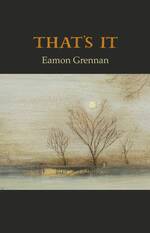
That's It (2026) by Eamon Grennan
Eamon Grennan, a poet beloved by his peers — Derek Mahon wrote a Foreword for his first collection, Wildly for Days (1983) — has been winning new admirers. Among younger poets, Molly Twomey and Kevin Graham have recently dedicated poems to him. A poet who knew from the beginning the values and rewards of paying attention finds himself at the opening of That’s It, his final book of poems, ‘in the dark’, ‘in numbered days and nights’, from which he takes abiding comfort in the solace of language.
The collection describes a present where ‘there’s nothing left — / not even the memory’. But Eamon Grennan’s resilience endures while — as ever in his poetry — there are birds, ‘their sweet salutes’, a ‘symphony orchestra / that never slips out / of time or tune’. This moving, sorrow-filled book still finds ‘first leaves / of the fresh, hope-lit / autumn morning’. It is a testimony to a special spirit.
Cover art: ‘Trees Guided by the Darkness’ by Mary Donnelly, mixed media on panel with wire, 18 x 13cm

Midnight at the Saltmarsh (2026) by Martina Dalton
Martina Dalton’s patiently assembled first collection, Midnight at the Saltmarsh, opens with a poem that recounts a story laden with mystery. Other poems swerve between the record of experience — there’s a ‘woman / wearing make-up // on only one side of her face’, a poem recording the shock of new birth (‘The Cord’) and another the last day outing with her father, the day she hoped ‘the sun could do without its sunset’. The title poem invokes the wisdom of Rilke.
Economical lines display finely observed details: a kingfisher ‘igniting / twig on twig’, a walking stick (her father’s?) whose ‘shadow casts its question mark’ and a kestrel ‘hanging from the sky by a thread’. The book culminates in a series of poems set in The Black Valley of County Kerry in which the author confronts her isolation. In poems of loss and healing Midnight at the Saltmarsh bravely reveals a woman’s lived life, her needs, longings and satisfactions.
Cover: ‘Incoming Tide, Achill’ by Paul Henry, © Sotheby’s. All rights reserved.
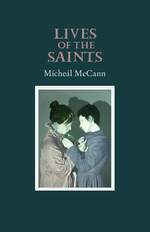
Lives of the Saints (2026) by Mícheál McCann
‘Mícheál McCann’s debut collection, Devotion, is a stately book — courtly, even.’ So wrote Declan Ryan in The Irish Times. In that rapturously received first book the author applied a modern setting, sensibility and set of references to a classic Irish lament. In Lives of the Saints he builds on biographical details of Christian figures and situates them in contemporary states of experience and emotion. Centrepieces of this eclectic collection are an ode to a recycling centre and ‘The Impossible Request’ in which the poet’s grandmother forgets that he has told her that he is gay (‘I know, pet, I know’) and asks if he has any girlfriends yet. Assured in its risks, vigorous in its enthusiasms, from its first ecstatic injunction Lives of the Saints is a collection to make one think and feel, then think again.
As I drive home, without shame, I decide on the name
of a girlfriend and her smile will be as wide as the morning.
— ‘The Impossible Request’
Cover: ‘Synaptic Pruning’ (2024) by Ciana Fitzgerald, oil on canvas, 80cm x 60cm
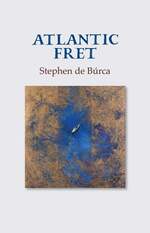
Atlantic Fret (2026) by Stephen de Búrca
Atlantic Fret unveils a focus, indeed a constancy of purpose, uncommon in a first collection. From the Blasket Islands in the opening poem to Iceland — the book concluding with adaptations of an Icelandic modernist classic — Stephen de Búrca embraces the idea of the Atlantic Ocean as the source of chaos from which the Cosmos grew. Against the backdrop of climate change the Ocean shares the burden of grief while offering a space for sexual freedom and self-expression.
In its impressive range of formal attainment, including the elegiac title sequence and the imaginative ‘Tide Clock’ sequence, Atlantic Fret reveals a writer sensitively attuned to inner and outer tensions, ‘to what the reeds, / curving like fishing rods, might be reeling in — // the shadows of small fish, the currents / at odds with one another, the river coming to terms / with sea water’. The result is a poetry collection that is genuinely affecting.
Cover: Anne Madden, ‘Sightline II’, 1995, oil on canvas, 173 x 171cm © The Estate of Anne Madden