tag:dublin.nd.edu,2005:/news-stories/newstag:dublin.nd.edu,2005:/latestNotre Dame Dublin | News2026-11-11T07:55:00-05:00The gateway to an authentic Irish experience for all those from the Notre Dame family who visit Dublin.tag:dublin.nd.edu,2005:News/1869522026-11-11T07:55:00-05:002026-11-11T07:55:02-05:00Notre Dame to launch new Department of Bioengineering
The University of Notre Dame’s College of Engineering is adding a new academic department in a field critical to the University’s strategic aspirations: bioengineering.
Over the past two decades, the University’s doctoral and minor programs in bioengineering have seen tremendous demand. With 17 affiliated faculty across six existing departments, the doctoral program alone has grown by 150 percent to more than 50 students over the last five years, while nearly 50 students are pursuing the undergraduate minor in bioengineering.
“This is a historic moment for both Notre Dame and the College of Engineering,” said Patricia J. Culligan, the Matthew H. McCloskey Dean of the Notre Dame College of Engineering. “Engineering’s last new department was established over 35 years ago, and I am incredibly excited for our talented bioengineering faculty and staff to seize this opportunity and propel a well-established and respected program to new heights.”
“This new department is an exciting step in advancing Notre Dame as the leading global Catholic research university,” McGreevy said. “It will enable us to do even more and better research and to train students in an area where many of the most important questions facing both engineering and science are going to be addressed.”
The formation of a new department will allow Notre Dame to offer a new bioengineering undergraduate degree to educate tomorrow’s leaders pursuing life-changing research and technologies. At the graduate and faculty level, it will enable the University to consolidate and focus its faculty and research programs on existing strengths and strategic priorities.
The inaugural chair of the new department will be Pinar Zorlutuna, the Roth-Gibson Professor of Bioengineering at Notre Dame.
Initial focus areas will include preclinical research through tissue engineering and engineered disease models to reduce dependence on animal testing; new devices and diagnostic tools for improving healthcare for all; and emerging frontiers for bioengineering technologies such as biocomputing and bioengineering research in the unique microgravity environment of space. Discoveries made through these impactful fields will be primed for translation into new products and companies through the University’s IDEA Center.
Already ranked No. 62 by U.S. News & World Report despite not having a home department, the bioengineering graduate program will now be better situated to compete for prestigious national awards and grants to expand its impact and collaborative networks. And with a global network of 12 locations across 10 countries, Notre Dame is well-positioned to impact healthcare worldwide, especially for people in low-resource areas.
The inaugural chair of the new department will be Pinar Zorlutuna, the Roth-Gibson Professor of Bioengineering at Notre Dame. With more than 10 years of experience at Notre Dame and as the current director of the bioengineering graduate program, Zorlutuna is poised to continue driving the growth and development of bioengineering at Notre Dame.
“It is an honor to be the first chair of Notre Dame’s Department of Bioengineering, and I am very excited to lead this effort,” said Zorlutuna, whose research focuses on important health problems such as cancer, heart disease, and aging. “The research portfolio we are bringing together—and expanding on through several new faculty searches—truly has the potential to transform lives.”
The Notre Dame Department of Bioengineering is set to commence operations on July 1, 2027. Over the coming months and years, the department will fill roughly 17 faculty positions through internal transitions and strategic external hires while working to formulate and launch a new undergraduate degree in bioengineering.
Media contact: Erin Blasko, director of media engagement, eblasko@nd.edu, 574-631-4127
Originally published by Ken Kingery at news.nd.edu on November 10, 2026.
]]>
Ken Kingerytag:dublin.nd.edu,2005:News/1849752026-08-21T08:35:00-04:002026-08-21T08:35:50-04:00Kylemore Abbey and the University of Notre Dame celebrate a decade of partnership at Threshold Festival
Kylemore Abbey and the University of Notre Dame at Kylemore Abbey proudly marked 10 years of their partnership during the Threshold Festival, a four-day celebration of literature, music, theatre, visual art, scholarship, and hospitality in the extraordinary setting of Kylemore Abbey.
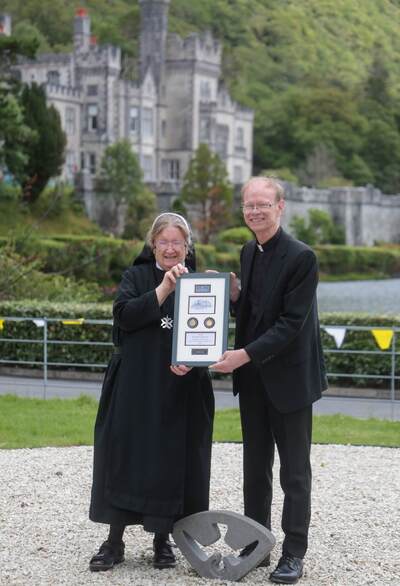
The anniversary was marked with a special presentation from the Benedictine Community of Kylemore to Rev. Robert A. Dowd, C.S.C., president of the University of Notre Dame, on Thursday, July 30. The presentation commemorated the first decade of a landmark 30-year agreement between Kylemore Abbey and the University of Notre Dame, which established the University’s global campus within the historic St. Joseph’s Wing of Kylemore Castle.
Since welcoming its first students in 2016, the University of Notre Dame Kylemore has become a vibrant hub for academic study, leadership development, research, retreats, workshops, and international events, developing meaningful connections between Ireland and the Notre Dame community.
This year’s Threshold Festival, themed “The Smiling Public Figure: Wit, Satire and Irony in W.B. Yeats,” brought together leading scholars, artists, performers, and cultural partners to explore Yeats’s work and legacy through performance, conversation, and creative encounters.
Festival highlights included the launch of the visual art exhibition Threading the Threshold: Care, Craft, and Celtic Revival, and an opening banquet celebrating Connemara hospitality. The weekend also featured live music in Kylemore's Gothic Chapel, including a performance by NoCrows and an intimate unplugged set from Steve and Joe Wall of The Stunning.
Academic and cultural programming featured leading voices in Irish studies, including Oxford historian and Yeats biographer Professor Roy Foster, who delivered a lecture on humour and Yeats; Professor Clemens Sedmak, director of the Nanovic Institute for European Studies, who spoke on "Learning from the Benedictines: Dignity, Flourishing, and Integral Human Development"; and Yeats postdoctoral fellow Eilís Smyth, who gave a talk on Shakespeare, Yeats, and the Lyric Theatre.
A major highlight of the weekend was the Abbey Theatre’s contribution to the festival programme. The Abbey Theatre presented a panel discussion, “You Have Disgraced Yourselves Again,” reflecting on Yeats, Lady Gregory, the Irish dramatic movement, and the continuing role of Irish theatre in shaping cultural life. The Abbey Theatre also presented a staged reading of Yeats’s The Green Helmet: An Heroic Farce in the Gothic Chapel, vividly bringing Yeats’s wit, mythic imagination, and theatrical energy to life.
The festival concluded with a special black-tie evening in partnership with Wexford Festival Opera, featuring Wexford Sings: Italy Through the Eyes of Yeats. The performance paired Italian opera by composers including Verdi, Puccini, and Rossini with Yeats’s poetry, creating a distinctive conversation between music, poetry, wit, and place.
Lisa Caulfield, director of Notre Dame Kylemore, said, “It was an amazing weekend in every sense—full of beauty, laughter, conversation, music, theatre, and friendship. I feel so grateful to be surrounded by such good people and such high-calibre artists, scholars, and partners. Their generosity, talent, and spirit made Threshold a very special celebration, and a fitting way to mark 10 years of Notre Dame Kylemore.”
As part of the anniversary celebrations, the Benedictine Community presented Fr. Dowd with a commemorative gift in recognition of the enduring partnership and the shared vision that has shaped the success of the Kylemore campus over the past 10 years. The celebration also included a special anniversary Mass with the Benedictine Community, celebrated by Fr. Dowd, marking 10 years of Notre Dame’s presence at Kylemore Abbey.
Reflecting on the milestone, Kylemore Abbey and the University of Notre Dame reaffirmed their commitment to continuing this unique collaboration, which brings together academic excellence, cultural exchange, and the Benedictine values of hospitality, community, and lifelong learning.
Speaking at the celebration to mark the anniversary, Abbess of Kylemore, Mother Karol O’Connell OSB, said:
“Since the foundation of our Benedictine Community in Ypres, Belgium in 1665, education has been at the heart of our mission. Generations of girls attended our schools, and today, through our Education and Retreat Centre, we continue to make Kylemore a place of learning. Our partnership with the University of Notre Dame is another mark of this commitment to education, and we look forward to the further flourishing of this partnership.”
Fr. Dowd, said:
"We are delighted to mark 10 years of partnership between Notre Dame and the Benedictine Community at Kylemore Abbey. As a global Catholic research university, we are grateful for the ways that the partnership has deepened our connectedness to Ireland and furthered our efforts to educate in ways that build bridges across disciplines, ideas, peoples, and cultures. We are deeply grateful for the vision of Martin and Carmel Naughton and of Mother Máire Hickey OSB who made this unique partnership possible. As we celebrate 10 years, we look forward to the future in a spirit of collaboration and partnership."
We remember the late Martin Naughton, whose vision and generosity were instrumental in bringing the campus to life. In May 2026, our Research Programmes Manager, Emma Kirner, interviewed Naughton about the University of Notre Dame Kylemore. Asked to describe it, he offered the following: “Notre Dame Kylemore is a spiritual place.”
Over the next two decades, Kylemore Abbey will continue to welcome generations of Notre Dame students, scholars, faculty, alumni, and visitors to the unique Connemara estate. Through this partnership, Kylemore will continue to strengthen its role as a place of learning, reflection, cultural exchange, and global engagement.
Media Contact: Lily Mansfield, lmansfi4@nd.edu
Originally published by Lily Mansfield at kylemore.nd.edu on August 20, 2026.
]]>
Lily Mansfieldtag:dublin.nd.edu,2005:News/1849652026-08-21T08:22:00-04:002026-08-21T08:22:08-04:00Two Notre Dame faculty members and University Trustee appointed by Pope Leo XIV as consultors to the Dicastery for Promoting Integral Human DevelopmentEmmanuel Katongole, Clemens Sedmak, and Kathryn “Katie” Koch have been appointed by Pope Leo XIV as consultors to the Dicastery for Promoting Integral Human Development.
On Tuesday (Aug. 18), Pope Leo XIV appointed two University of Notre Dame faculty members, Emmanuel Katongole and Clemens Sedmak, as consultors to the Dicastery for Promoting Integral Human Development. University Trustee Kathryn “Katie” Koch, president and CEO of TCW, a global investment management firm, was also named a consultor.
Katongole, a professor of theology and peace studies and director of the Ansari Institute for Global Engagement with Religion; Sedmak, a professor of social ethics and director of the Nanovic Institute for European Studies; and Koch are among 12 new consultors from around the globe—and the only three selected from within the United States. They have been appointed for a five-year term.
Consultors may be religious or laypeople and are chosen “from among the faithful who are distinguished by their expertise, proven ability, and prudence,” according to the Vatican’s announcement.
“These appointments are a tremendous honor not only for Emmanuel, Clemens, and Katie, but for the University as a whole,” said Notre Dame President Rev. Robert A. Dowd, C.S.C. “We congratulate them on their selection, and we are deeply grateful for the Holy Father’s recognition of their expertise and abiding commitment to the Church. We look forward to the ways their leadership and wisdom will guide the important work of the dicastery.”
Established by the late Pope Francis in 2016, the Dicastery for Promoting Integral Human Development supports the Church’s worldwide efforts in the areas of human dignity and human rights, economic justice, care for creation, migration, and displacement, as well as peace, conflict, and humanitarian crises.
Katongole, who came to Notre Dame in 2013, holds a joint appointment in the University’s College of Arts and Letters and Keough School of Global Affairs. A native of Kampala, Uganda, and a priest of the Kampala Archdiocese, he is the founder and president of Bethany Land Institute, a residential agricultural institute that works with young people to realize the vision, spirituality, and practice of Laudato si’ in Uganda. Before joining the Notre Dame faculty, he served as an associate professor of theology and world Christianity at Duke University and was a founding co-director of the Duke Center for Reconciliation. He earned a Bachelor of Divinity at the Pontifical University Urbaniana in Rome, as well as a master’s in religious studies and a doctoral degree in philosophy from the Catholic University of Louvain in Belgium.
Sedmak, a concurrent professor of theology, holds a joint appointment in Notre Dame’s Institute for Social Concerns and the Keough School. His research focuses on issues of poverty, justice, and the Catholic social tradition, as well as a collaboration with Notre Dame colleagues on the Church’s role in acclimating refugees into Italian society. A native Austrian, Sedmak holds a doctoral degree in theology from the Catholic Private University of Linz and doctoral degrees in philosophy and social theory from the University of Innsbruck. Prior to joining Notre Dame, Sedmak served as the F.D. Maurice Professor for Moral Theology and Social Theology at King’s College London. He also held multiple positions at the University of Salzburg and was president of the Institute for Advanced Studies in Social Ethics in Salzburg.
Koch, a Notre Dame alumna, was named a University Trustee in 2023. Prior to moving to TCW, she spent 20 years at Goldman Sachs in a variety of leadership positions, including chief investment officer of public equity. She graduated from Notre Dame in 2002 with a Bachelor of Arts in economics and English.
Originally published by Carrie Gates at news.nd.edu on August 20, 2026.
]]>
Carrie Gatestag:dublin.nd.edu,2005:News/1849092026-08-19T07:48:00-04:002026-08-19T07:48:22-04:00Notre Dame announces inaugural Arts Biennial featuring prominent artists from around the worldDisobedient Robots, Nicolás Kisic Aguirre, 2026. Interface, presented by Michigan Central Art and Newlab Detroit. Image by Christian Lathers, courtesy of Nicolás Kisic Aguirre
The inaugural Notre Dame Arts Biennial, which runs January through June 2027, will feature more than 100 public events, including exhibitions, performances, community workshops, and guest artists slated to visit the South Bend area for a six-month festival of visual, literary, spatial, and performing arts. Most events are free to attend.
The biennial—thematically focused on the concept of symbiosis—is produced by the Notre Dame Arts Initiative and curated by Initiative Director Michael Schreffler and Managing Director Rebecca Struch.
“Notre Dame’s flourishing is deeply connected to the vitality of South Bend and its surrounding communities,” said University President Rev. Robert A. Dowd, C.S.C. “The Arts Biennial exemplifies how the University’s commitment to the arts advances our Catholic mission by using creative expression to foster meaningful cultural exchanges and contribute to a thriving shared home.”
Highlights of the biennial will include a fireside chat with Maya Lin, a visionary artist and architect well-known for designing the Vietnam Veterans Memorial in Washington, DC. Zadie Smith, author of the acclaimed novel White Teeth, and Sougwen Chung, widely regarded as a pioneer of artistic human-machine collaboration and one of Time’s 100 Most Influential People in AI, are two featured speakers at the Franco Family Institute for Liberal Arts and the Public Good’s Dorothy Day and Thomas Merton Culture and the Public Good Symposium. Writer and photographer Cig Harvey will deliver the John J. Reilly Center for Science, Technology, and Values’s annual Ruskin Lecture. Claudia Bernardi, internationally known for her work in the fields of visual art, human rights, and social justice, will join for a weeklong residency bridging Notre Dame and South Bend.
“The Arts Initiative is a powerful catalyst that energizes creative inquiry and practice across the University,” said Schreffler, a professor of art history and associate dean for the arts in the College of Arts & Letters. “A massive undertaking like a biennial festival is made possible only through sustained partnerships with the many faculty and staff who bring research and teaching expertise to our public arts programming.”
The DeBartolo Performing Arts Center and Raclin Murphy Museum of Art also announced some of their signature biennial programming in partnership with the Arts Initiative. The 96-member National Symphony Orchestra will perform, led by esteemed music director and conductor Gianandrea Noseda, and Hubbard Street Dance Chicago will perform at Notre Dame for the first time in nearly 20 years. The Raclin Murphy Museum of Art will unveil an expansive group exhibition of contemporary art, More Than: Artists in Collaboration for a Greater Good, which will remain on view to the public throughout the biennial.
Additional signature programming will be announced throughout the fall before the biennial’s opening in January.
“In our era of cultural fragmentation, the biennial’s inaugural theme of symbiosis is a radical invitation to re-examine our interconnectedness,” Struch said. “Together with more than 85 collaborating campus units and external organizations, we are actively cultivating an arts ecosystem rooted in accessible programming that brings people together.”
For others, Arts Initiative support provides critical resources to help launch new partnerships or new programs. The Robinson Community Learning Center and Notre Dame’s Department of Art, Art History, and Design have teamed up to design and install public art at Eddy Street Commons, which will be unveiled during the biennial. The Acting Ensemble; Equity in the Arts, an initiative of South Bend Venues Parks & Arts; Merrimans’ Playhouse; South Bend Community School Corporation; and South Bend Museum of Art are each launching arts education programs focused on cultivating the next generation of artists and audiences. The biennial also features regional collaborations beyond South Bend, including with Elkhart County’s Goshen College Music Center and Michigan City’s Lubeznik Center for the Arts.
Supported projects also reflect the biennial’s commitment to global artistic exchange. A guest artist residency with internationally prolific Chinese theater director Wang Chong will culminate in the English-language premiere of his acclaimed Lying Flat 2.0, an immersive, participatory theater work that integrates live-feed video projection and real-time use of AI. Qhapaq Qolla, one of the most influential dance troupes in the Peruvian Andes, will make its US debut in a weeklong residency at Notre Dame. A collaboration with Ukrainian Catholic University and ICONART Gallery in Lviv, Ukraine, brings an exhibition of contemporary Ukrainian sacred art and iconography to campus, and a collaboration with Notre Dame Global launches a new artist exchange program between Mexico City, Dublin, and South Bend.
For more information about the artists and events featured in the inaugural biennial, visit artsbiennial.nd.edu. Subscribe to the biennial newsletter and follow the Arts Initiative on Instagram and Facebook (@artsnotredame) for additional program announcements.
Contact: Erin Blasko, director of media engagement, 574-631-4127, eblasko@nd.edu
Originally published by Notre Dame News at news.nd.edu on August 18, 2026.
]]>
Notre Dame Newstag:dublin.nd.edu,2005:News/1847092026-08-13T13:51:00-04:002026-08-19T10:36:14-04:00The one thing you should know about Notre Dame DublinEimear Clowry Delaney, Michael J. Smurfit Director of Notre Dame Dublin
This story is part of Notre Dame Global's series titled "The One Thing."
In 2026, we are taking a new look at Notre Dame’s 12 global locations by asking each of their directors one question: “What is the one thing you would like the Notre Dame community to know about your programs, your achievements, your goals, or your aspirations?”
We focus now on Notre Dame Dublin, headed since 2024 by Eimear Clowry Delaney, Michael J. Smurfit Director, who joined the Keough Naughton Notre Dame Centre in 2008 and previously served as its senior associate director.
What is the one thing you want the Notre Dame community to know about Notre Dame Dublin?
“Student learning and teaching are at the core of everything we do.”
EIMEAR CLOWRY DELANEY: Notre Dame Dublin was founded in 1998—nearly 30 years ago. That is our origin story—we began as a student center, a learning center in Dublin. All of our current programs and collaborations spring from that history.
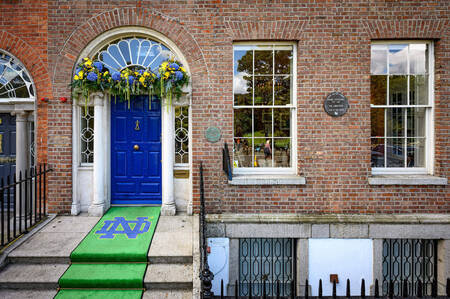
Front door of O’Connell House in Dublin, Ireland
Since the center’s founding, the Notre Dame students who come to Dublin have been the pathfinders in Ireland for the University as a whole and for its many collaborations with Irish society more broadly. The fifty or so undergraduates who come to us each semester for a study abroad experience attend classes—and are fully immersed—in one of three universities: Dublin City University, Trinity College Dublin, or University College Dublin. And, when one of us at O’Connell House encounters a potential partner or collaborator—if they've had an experience with our students—they are more than willing to engage with us. They trust us based on the experiences they've had with our young people—whether through one of the three universities or through one of our many internship placements during the semester or summer—at the National Gallery of Art or the Department of Foreign Affairs, for instance.
A beautiful, organic respect has been built for Notre Dame as an institution through these outstanding young people, from their desire to be in Ireland, their curiosity for the island they inhabit, and for their work during the time they're with us.
Why is that one thing—that student learning and teaching are at the core of everything you do—so important to Notre Dame Dublin?
“Making student learning and teaching central is how we engage with the purpose of a university—to educate and to inspire brilliant young minds to not only transform the world, but to transform how they see the world, how they feel in the world, and how they want to be in the world in the future.”
EIMEAR CLOWRY DELANEY: Our students come to us with ambition, curiosity, drive, creativity, and diverging opinions. That makes them brave, and these qualities make us brave, too.
Related to that bravery, one thing I am passionate about is that a part of studying abroad, researching abroad, and learning abroad is getting lost. If a program is too prescriptive, students aren’t able to see that while Ireland is an ancient island, we are also very advanced in today’s world. That can surprise some young people—but that can only happen if they are given the opportunity to explore, to get lost a bit, and go farther and deeper than one does with a typical tourist experience.
Professor Kevin Whelan teaches the poetry of W.B. Yeats as the students sit atop Knocknarea, County Sligo, on what is said to be ancient Celtic warrior goddess Queen Medb's Cairn, a 5,000-year-old neolithic passage tomb. The culture, landscape, and folklore in this area of Sligo, now known as "Yeats Country," was hugely influential to W.B. Yeats.
For that reason, here at Notre Dame Dublin, our core focus is building community, learning, and growing together through, as we say, “the soles of our feet.”
Our motto is Is ar scáth a chéile a mhaireann na daoine, an Irish proverb that translates to "People live in the shelter of each other,” reflecting our interconnectedness and reliance on community to survive and thrive.
The hundreds of students who have embraced this way of study abroad are a testimony to its effectiveness. One such student is Meera Baakta ‘26, who says, “In Dublin, I was able to explore questions similar to those across science and development that I studied at Notre Dame’s home campus, but within a different intellectual and social ecosystem. Connecting with professors and peers across courses such as Trinity College Dublin’s EthicsLab, I was able to expand my understanding of complex dilemmas and enrich my experience by learning alongside people formed by different histories and perspectives. I also began to learn the Irish language in classes at O’Connell House, and then continued my studies back on campus.” See Meera's story below
What does that one thing reveal about Notre Dame Dublin and Ireland overall?
“We Irish are a curious people, an island of people within a very small land mass who live in close proximity to each other. We build strong relationships within our own, sometimes parochial, communities. But we thrive in getting to know new people, and that curiosity—of wanting to interrogate, discuss, converse, or debate with others—is a very strong part of Irish culture.”
EIMEAR CLOWRY DELANEY: This quality of curiosity about how others think is at the core of who we are as a people. And, to be able to bring new people into the fold who may not think the same, that in itself is very Irish.
Curiosity works both ways. A key opportunity with international education is to understand that, wherever they claim citizenry, people are not really that different. The challenges we face are very much shared. With that realization comes a desire to problem-solve together. So, as a little island on the periphery of the Atlantic and of Europe, we Irish have traditionally felt rather isolated and alone. But now, Ireland has taken on a new identity—one of being a changemaker. We have a tiny population, but we have a very significant voice in the world. We will flourish and thrive only if we share that with the world and invite and welcome other people to be with us.
As part of the Translating Ireland Conference, University of Notre Dame professor Clíona Ní Ríordáin chaired the "Translating Irish Literature out of Ireland" panel discussion, which featured translators Marco Sonzogni (Victoria University, New Zealand), Marie Hermet (France), and Indrek Õis (Estonia).
Interrogating how Ireland has been a changemaker was one of the subjects of the “Translating Ireland” symposium Notre Dame Dublin hosted with several partners this past April to mark the 30th anniversary of the publication of the influential book by Michael Cronin, Translating Ireland. Led by Clíona Ní Ríordáin, the Thomas J. and Kathleen M. O’Donnell Chair in Irish Language and Literature, participants explored the central role translation played in the contact zone between languages as well as how it shaped the development of the languages of literature and the construction of identity in Ireland.
Looking ahead, I am very excited about an upcoming partnership within the University’s Arts Initiative between Notre Dame Dublin and Notre Dame Mexico. We are excited to make a joint announcement soon that will include all the details.
Learn more about the work of Notre Dame Dublin and the University of Notre Dame’s global network, or browse related articles:
Learn more about the collaborative work and partners of Notre Dame Dublin
The Legacy of Daniel O’Connell
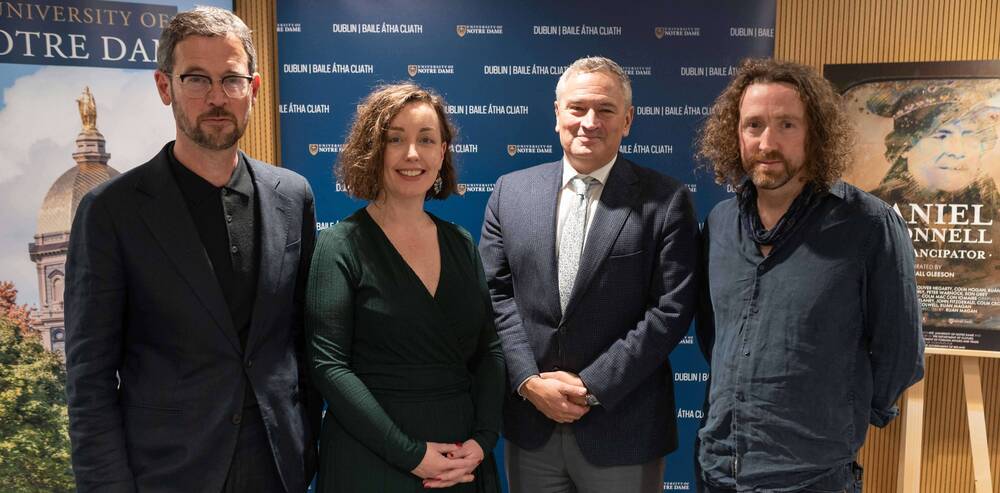
Eimear Clowry Delaney, Michael J. Smurfit Director of Notre Dame Dublin, attends the Daniel O’Connell: The Emancipator documentary premiere alongside (left to right) the documentary director Ruán Magan, University of Notre Dame Vice President & Associate Provost Michael Pippenger, and composer and musician Colm Mac Con Iomaire.
The Keough Naughton Notre Dame Centre at O’Connell House is the home of Notre Dame Dublin. Located at Number 58, Merrion Square, the centre was once home to the celebrated early nineteenth-century Irish Catholic political leader Daniel O’Connell.
O’Connell is the subject of a documentary titled Daniel O’Connell: The Emancipator, produced by Create One in association with the University of Notre Dame, University College Cork, and RTÉ, Ireland’s national television and radio broadcaster.
The documentary traces O’Connell’s journey from Kerry lawyer to global advocate for justice. Known as “The Liberator,” he secured Catholic Emancipation, pioneered non-violent mass political mobilization, and inspired democratic movements around the world.
The release of Daniel O’Connell: The Emancipator will form part of a four-year-long program of commemorations and research, from O’Connell’s 250th birthday in 2025 to the 200th anniversary of Catholic Emancipation in 2029, inviting audiences to reflect on how his vision for justice and democracy continues to shape our world.
The gala premiere of the documentary was held in Dublin in November 2025.
There will be a screening of The Emancipator on the Notre Dame campus Friday, November 13th, at the DeBartolo Performing Arts Center, and another screening at the Chicago Consulate Film Festival on Sunday, November 15th.
More than a Semester Abroad
Meera Bhakta, ‘26
Meera Bhakta ‘26 graduated with a major in science preprofessional studies and a minor in international development. During the spring 2025 semester, she studied at Trinity College Dublin and will return to Trinity this fall as a Naughton Fellow pursuing a masters of science degree in translational oncology.
MEERA BHAKTA: For my study abroad experience at Notre Dame, I explored programs from Santiago to Copenhagen, hoping there would be a clear sign pointing me in one direction. Eventually, I chose Trinity College Dublin because it allowed me to take a wide range of courses I was interested in and would allow me to fully integrate into a host university. At the time, I had researched Trinity extensively, but I knew relatively little about Ireland itself. Looking back, that is part of what made the experience so impactful. By not knowing, I was open to the surprises Ireland had in store for me.
In Dublin, I was able to explore questions similar to those I studied at Notre Dame across science and development, but within a different intellectual and social ecosystem. Connecting with professors and peers across courses such as EthicsLab, I was able to expand my understanding of complex dilemmas and enrich my experience by learning alongside people formed by different histories and perspectives.
Beyond the classroom, Dublin also impacted me through the people and communities I engaged with. Every Tuesday, I volunteered with an after-school program at St. Catherine’s Church through the Solas project. Some afternoons were spent helping with homework, others playing outside, organizing holiday activities, or sharing stories. Those Tuesdays filled my semester with an unexpected source of laughter and friendship, and taught me about allowing myself to be shaped by the people around me.
O’Connell House also became a valuable home base throughout the semester, providing a place for conversations, reunions with friends studying across the city, tea and digestive breaks, and opportunities to learn more about the Irish language, history, and culture. I began studying Irish through classes there, and then continued my studies back on campus.
I am so grateful to be returning to Dublin this fall with the support of the Naughton Fellowships to pursue an MSc in Translational Oncology at Trinity College Dublin. My time in Dublin helped me to see Ireland not just as a semester abroad, but as a place where I can continue to grow intellectually, personally, and professionally. I hope to continue studying the Irish language upon my return and plan to visit the Gaeltacht.
Imagallamh: the Keough-Naughton Summer School in Irish Studies
Declan Kiberd delivering a lecture to the graduate students attending Imagallamh, the Keough-Naughton Summer School in Irish Studies
A summer seminar for graduate students in the humanities is held every year in Ireland between Notre Dame Dublin and Notre Dame Kylemore.
Called “Imagallamh,” which means “mutual discourse,” the seminar seeks to emphasize the international and comparative elements of Irish studies. It also aims to bring the next cohort of scholars in the field into meaningful dialogue with one another and with key figures in Irish scholarship, the arts, and society. In addition to Notre Dame students, this year’s cohort included students from Britain, Canada, India, Ireland, Italy, Latin America, and the US. Each student received a fully-funded scholarship.
Directed by Barry McCrea, the Donald R. Keough Family Professor of Irish Studies and Professor of English at the University of Notre Dame, with the collaboration of Clíona Ní Ríordáin, the Thomas J. and Kathleen M. O’Donnell Chair in Irish Language and Literature, Imagallamh was launched in 2024 as a new iteration of the Keough-Naughton Institute’s IRISH Seminar, which ran from 1999 to 2022. That seminar was held in Ireland and locations around the globe, with such themes as Ireland and Britain, Classical Influences, Irish Modernisms, Ireland and Italy, and Peripheral Modernities: Ireland, Argentina, and Latin America.
The theme of the 2026 Imagallamh seminar was Urban Ireland. Across two weeks, students engaged with academics and writers to explore the historical, cultural, and literary dimensions of settlement on the island—from its earliest origins, including prehistoric settlements, early monastic complexes, Viking towns, and British garrisons, through to the life of Ireland’s modern cities.
Some highlights of the Dublin week of the seminar included lectures on Sean O’Casey and the development of Dublin’s built environment from the Georgian city through independence, an interdisciplinary conversation between leading Dublin architects and poets, and a trip to the Tenement Museum on Henrietta Street.
Originally published by Mary Hendriksen at global.nd.edu on August 11, 2026.
]]>
Mary Hendriksentag:dublin.nd.edu,2005:News/1829222026-07-07T14:00:56-04:002026-07-07T14:00:56-04:00Notre Dame Arts Initiative awards over $400,000 for community and campus partners to lead inaugural Arts Biennial programming
The Notre Dame Arts Initiative has awarded 38 grants to foster sustained growth in the arts through partner programming for the inaugural Notre Dame Arts Biennial, scheduled for January through June of 2027. Awardees include 16 regional community partners, 19 campus units, and four Notre Dame Global locations, with another 60 campus units and external organizations involved as collaborators. In addition to funding, partners receive administrative support from Arts Initiative staff for planning, implementation, and promotion.
Projects include theatrical premieres, regional dance and music festivals, multimedia installations, visual art and architecture exhibitions, high-impact arts education programs, international artistic exchange, and more. Biennial programming is open to the public, and events will be held on Notre Dame’s campus, in and around South Bend, and at select global locations.
Occurring every two years, the biennial is an international arts festival rooted in the creative spirit, intellectual energy, and iconic traditions of Notre Dame and the region. Predominantly free programming across the visual, spatial, literary, and performing arts will contribute to the region’s long-term flourishing by enhancing quality-of-life and quality-of-place and by providing new platforms for arts research to positively impact the public.
In his inaugural address, University President Rev. Robert A. Dowd, C.S.C., urged the Notre Dame community to be builders of bridges to live out our mission as a leading global Catholic research university. The biennial is one of the most visible ways the Arts Initiative is responding to that call.
“This scale of coordination and collaboration is unprecedented,” said Michael Schreffler, director of the Notre Dame Arts Initiative. “We are grateful to all of our partners for bringing their energy and leadership to fully realize the vision of the biennial’s inaugural theme of symbiosis: a call to contemplate mutually-beneficial relationships through the arts and create them together in practice.”
Community partners leading biennial programming reflect the strength and diversity of arts and culture across the region. Participating regional community partners include:
Abby Marchesseault Dance Collective
Acting Ensemble
Equity in the Arts, an initiative of South Bend Venues Parks & Arts
Goshen College Music Center
Fischoff National Chamber Music Association
The History Museum
Lubeznik Center for the Arts
Merrimans’ Playhouse
New Industry Dance
Performing Media Festival, produced in partnership with IU South Bend
Saint Mary’s College, Department of Art
South Bend Civic Theatre
South Bend Community School Corporation
South Bend-Elkhart Regional Partnership
South Bend Museum of Art
South Bend Symphony Orchestra
Campus units awarded funding for partner programming similarly span artistic media and represent a University-wide commitment to interdisciplinary innovation. In addition to projects housed in arts departments, campus efforts are also being led by the College of Science, Hesburgh Libraries, the School of Architecture, and a range of interdisciplinary centers and institutes.
Beyond robust support for partner projects, the biennial also closes gaps in cultural access by attracting prominent artists to the region and making the highest-caliber arts experiences available to the public. In addition to world-class artists hosted by the Arts Initiative, signature performances, convenings, and exhibitions aligned with the biennial’s inaugural theme will be hosted by the DeBartolo Performing Arts Center, the Franco Family Institute for Liberal Arts and the Public Good, and the Raclin Murphy Museum of Art.
A dual emphasis on local and visiting artists is a hallmark of Notre Dame’s biennial. “We’re not aware of any other U.S. university currently curating a biennial of this nature and scale,” said Rebecca Struch, Arts Initiative managing director. “Establishing a groundbreaking biennial in northern Indiana, a place with an evolving but often overlooked arts scene, will advance the region as a global gathering place for arts and inquiry.”
“The Notre Dame Arts Biennial reflects what’s possible when our community and local institutions work together,” said South Bend Mayor James Mueller. “This effort will activate our public spaces, support local artists, and strengthen the connections that make South Bend a vibrant place to work and live.”
The Arts Biennial launches at a pivotal moment for the arts across the region and on campus. Informed by its Catholic character, the University’s most recent strategic framework identifies the arts as a key priority and calls for deeper engagement with South Bend and the region. The South Bend-Elkhart region also recently adopted a new Arts & Culture Plan. The biennial builds on these developments by nurturing the arts as a shared community asset that strengthens social bonds and shapes place-based identities.
Contact: Rebecca Struch, Arts Initiative managing director, 574-631-9845, rstruch@nd.edu
Originally published by Arts Initiative at arts.nd.edu on July 06, 2026.
]]>
Arts Initiativetag:dublin.nd.edu,2005:News/1813472026-05-04T08:10:00-04:002026-05-04T08:10:27-04:00International partners boost peace agreement success, Notre Dame study finds
Over the past 50 years, nearly 4 in 10 peace agreements have failed within five years of signing. New research shows that when international partners help implement an accord, the odds improve — and the deeper their engagement, the better.
Colombia’s 2016 peace accord ended over 50 years of armed conflict. It has had high levels of global support, from negotiation to implementation. Photo by Gobierno de Chile (Government of Chile), CC BY 2.0, via Wikimedia Commons.
That’s according to a study by University of Notre Dame researcher Madhav Joshi. The study, published in the Journal of Intervention and Statebuilding, shows how the visible, on-the-ground presence of partners such as foreign countries, multilateral institutions and policy advocacy organizations keeps peace agreements on track by raising reputational costs for leaders who fail to implement them.
Joshi’s research drew on evidence from the historic 2016 Colombian peace accord between the government and the Revolutionary Armed Forces of Colombia-People’s Army (FARC-EP), which illustrates these dynamics in practice.
The Colombian agreement has had high levels of global involvement, from negotiation to implementation. More than 30 international actors have helped support the agreement, including the European Union, the United Nations Development Programme, the Carter Center and the U.S. government.
Joshi used data from the Peace Accords Matrix Barometer Initiative, which is responsible for monitoring and verifying implementation of the accord. This is the first time a university-based research center has played such a direct role in supporting the implementation of a peace agreement, and the first time researchers have measured the implementation of a peace accord in real time.
Drawing on this data, Joshi tracked 578 individual commitments from December 2016 through April 2023. He found that international support, and the depth of that support, directly improved implementation outcomes.
Previous research has shown that domestic leaders often fail to implement peace agreements either because they are politically costly or because leaders lose domestic political support. Joshi found that international partners bring expertise and resources to support the aspects of agreements that are most at risk. Crucially, he also found that partners’ involvement increases the visibility of these agreements. That motivates leaders to work through obstacles rather than risk losing face on the global stage.
“When domestic actors face higher reputational costs, they are less likely to shirk their commitment to implementing peace,” Joshi said.
Colombia’s story reflects these findings, Joshi said. When Iván Duque won the Colombian presidency in 2018 by rallying voters against the peace agreement, extensive international involvement meant he couldn’t walk away from it, despite his campaign promise.
Informing global peace policy and practice
Joshi’s research examines why peace agreements succeed or fail. These insights are an important part of the Peace Accords Matrix and its ongoing work to inform frontline policymakers and practitioners.
The new study builds on Joshi’s broader body of work, which examines why peace agreements succeed or fail. Previous research has explored how partial agreements can pave the way for more comprehensive deals and how addressing gender issues strengthens accords.
Joshi’s work plays a central role in the Peace Accords Matrix. It maintains the world’s largest collection of implementation data on intrastate peace agreements, informing the work of policymakers and practitioners.
The latest study carries direct implications for how future agreements are designed, Joshi said, adding that partners should be built into strategies from the start.
“To maximize the chances for success, negotiators should design strategies to incorporate partners before the agreement is signed and deploy them as soon as implementation begins,” Joshi said.
Contact: Tracy DeStazio, associate director of media relations, 574-631-9958 or tdestazi@nd.edu
Originally published by Josh Stowe at keough.nd.edu on April 28, 2026.
]]>
Josh Stowetag:dublin.nd.edu,2005:News/1807692026-04-14T07:35:00-04:002026-04-14T07:35:43-04:00Statement from University President Rev. Robert A. Dowd, C.S.C., in support of Pope Leo XIV
“Pope Leo XIV continues to proclaim the Gospel of Christ by upholding human dignity and serving as a tireless advocate for peace. His message transcends partisan political divisions in this or any country and I’m deeply grateful for Pope Leo’s inspiring example. I ask members of the Notre Dame community to pray for peace and work together with all people of goodwill to build a more just and humane world.”
Rev. Robert A. Dowd, C.S.C. President, University of Notre Dame
Originally published by Notre Dame News at news.nd.edu on April 13, 2026.
]]>
Notre Dame Newstag:dublin.nd.edu,2005:News/1804802026-03-31T11:49:00-04:002026-03-31T11:49:49-04:00Returning home: Keough-Naughton Institute sponsors the first Comórtas Larchet
In a new partnership the Feis Ceoil has staged its first Comórtas Larchet for choral work in the Irish language. The competition was sponsored by the University of Notre Dame’s Keough-Naughton Institute for Irish Studies with the premiere held Thursday, March 19, in the RDS Grand Hall in Dublin.
Comórtas Larchet winner Wesley College with composer Norah Constance Walsh
Post-primary choirs were invited to compete in performing Norah Constance Walsh’s new setting of the poem “Filleadh ar an gCathair” by Ailbhe Ní Ghearbhuigh, a contemporary poet from Tralee in Co. Kerry.
In this inaugural competition, the first prize of €750 and Certificate to Conductor went to Wesley College (conductor Helen Doyle) and second prize to King’s Hospital (conductor Ciarán Kelly).
Laura Gilsenan has been CEO of Feis Ceoil for almost two decades, having joined the organization from a human resources role as it transitioned into a company.
Gilsenan said that this year is the 130th anniversary of Feis Ceoil. “Composition has been part of Feis Ceoil since the very beginning,” she says. “We wanted to do a couple of things that would reignite some of the fundamental principles of why the Feis Ceoil was set up in the first place. There is a very strong composition tradition in Ireland.”
Founded in 1896 by Dr. Annie Patterson from Lurgan, Co. Armagh, a composer, organist and Gaelic League member, the Feis Ceoil takes place annually with 200 different competitions over March and June, and almost 5,000 students from as young as age seven performing for international adjudicators.
Ireland’s premier music competition, the Feis is a rite of passage for classical musicians in Ireland, having turned out many notable performers including singers Claudia Boyle, Tara Erraught, Celine Byrne, pianists John O’Conor and Finghin Collins, and violinist Cora Venus Lunny.
Going further back, a 22-year-old James Joyce won (to his disappointment) the bronze medal in the tenor solo competition in 1904, having been persuaded by gold-medal winner Count John McCormack to take part. Joyce’s bronze medal is in the possession of dancer Michael Flatley.
Irish rebel Eamonn Ceannt played uilleann pipes and adjudicated the piping competitions in 1915. Set to judge the competition again the following year, he was executed in Kilmainham Gaol in 1916 for his part in the Easter Rising.
The Feis has survived, says Gilsenan, because “the standard here is high. Adjudicators come from abroad, so people are not only being benchmarked against their peers, they’re being benchmarked internationally.”
Many participants go on to populate choirs, orchestras and opera houses in Europe and the US. “The vast majority of classical musicians working in Ireland have been through the Feis.” Of the competitions, “People find it hard to comprehend the scale of it,” says Gilsenan.
The founder’s vision was to revive Irish music through a classical repertoire and this is the key principle of the new Comórtas Larchet, named after the prominent Irish musician and teacher John F. Larchet.
Gilsenan may be busy with the hands-on running of the sprawling competitions, while keeping the company afloat, but she has also been a choral singer her whole life. When selecting the poem, “I had an idea what might be of interest to people of the level we’re looking at, aged between 14 and 17.”
She says, “We noticed that the numbers of Irish-language choirs were going down. We thought we could introduce interesting choral repertoire in the Irish language that would hopefully reignite people’s passion for it.”
Wesley College in performance
A ‘green wave’ of Irish-speaking musicians
From the Belfast Irish-language rappers Kneecap to pop star CMAT (who mixes Irish-language lyrics in her latest album, “Euro-Country”) to bilingual artists like Lankum and Róis, there seems to be a “green wave” of Irish-speaking musicians shaping international taste.
“I think we’re lucky with Kneecap and those kinds of people creating an Irish-language resurgence,” says Gilsenan. “A bit of a zeitgeist that we have inadvertently tapped.”
The poem by Ní Ghearbhuigh, “Filleadh ar an gCathair,” translated as “Returning to the City,” is a vibrant and tactile celebration of coming home to the bustle, heat and petrol fumes of a beloved city. It is a rewriting of Máirtín Ó Direáin’s poem “The Islander” with many accolades, chosen as Ireland's EU Presidency poem in 2013 and shortlisted in 2015 for RTE's “A Poem for Ireland.”
Norah Constance Walsh is a composer, musician and the artistic director of Dublin-based choirs The Mellow Tonics and the Forget Me Nots. She is also a former Feis entrant who performed on piano, before setting aside her musical career for a while.
“My journey was a little bit unusual because I had a career as a corporate banker before I went back to do a degree in music,” says Walsh. “I’d always been a musician. When I decided I wanted to take a break from one career, I didn’t return to the other. Composition has always been something I’d wanted to do.”
Walsh has set the works of numerous poets to music, including Dermot Bolger, Catherine Ann Cullen, Moya Cannon, Peter Sirr and Tony Curtis, and has composed short operas alongside her career as a conductor and musical director for such televised events as the 2018 Papal visit. “Vocal works are a core part of my compositional output because I love the ability to communicate a narrative and a feeling,” she says.
First contacted by the Contemporary Music Centre, Walsh was involved in selecting the poem from a list of 10 compiled by Gilsenan and others, including Notre Dame’s Professor Brian Ó Conchubhair. Of receiving the commission, she says, “An initial reading inspires a lot of instant ideas and thoughts.”
“The text was a particularly good choice for the competition because it was written by a young adult and the themes are those of young adults, although they ring absolutely true with me as an older adult. I thought the fit was good, it’s about returning to the city, full of life and vitality. It was so relatable to younger people. I had an image of these rows of young singers coming back to the city full of life, and how they’ve missed it.”
The poem is about Bordeaux, where Ailbhe Ní Ghearbhuigh spent time, though anyone who has journeyed home from an airport through their city streets will find very personal resonances in the poem.
What Walsh most liked about it was “this idea of coming back to the city, instead of some pastoral landscape or tumultuous seas.”
“The language she uses in describing the elements of the city is beautiful and yet slightly crude in places. She’s talking about the heat of the city, the taste of sweat which she finds to be pleasant, the neon lights that are lighting up her heart, the song of the traffic. We normally associate traffic with noise, with negative adjectives. Also this idea that ‘preabann an Aimsir Láithreach,’ the present tense, is throbbing or pulsating.”
“I was delighted to have the opportunity to set a poem in Irish,” she adds. “My son went to a Gaelscoil, and we speak a little at home. It’s a very rich part of my heritage.”
From left, adjudicator Oliver Hynes, conductor Helen Doyle, composer Norah Constance Walsh, Feis Ceoil CEO Laura Gilsenan, and presenter Pádhraic Ó Cuinneagáin
Gilsenan, who was involved in selecting the piece and in commissioning Walsh, hopes it may become part of the canon of repertoire in Irish choral singing. “When we come to next year we’ll hopefully have more people taking it up.”
She believes the Feis Ceoil has a greater reach than in fostering musical talent in its participants. “We are not only training musicians, but we’re training the audiences of the future as well. A lot of people come to music through their school choir or orchestra and hopefully retain a love of it.”
This year, along with the Comórtas Larchet, the Feis has added Community Choirs to its competitions. Ireland has a very strong choir culture, with long-running regional choir competitions and community choirs emerging throughout the country in recent years.
“There is a great benefit to people’s mental health with singing. A lot of people might have a memory of school choirs where they were told to mime because their voices weren’t strong enough, so to be able to participate fully is very empowering,” says Gilsenan.
“The sense of collaboration creates enormous well-being. Fostering that love of music will stay with people.”
“The Keough-Naughton Institute is well known for its visual arts and academic support, and the Feis Ceoil seemed a natural extension,” he says.
“The Feis Ceoil is an iconic aspect of Irish culture that predates the formation of the Irish state. It has a unique selling point that captures that tension where you might ask is Irish identity part of the high European classical music tradition or is it closer to some form of wild exotic Sean Nós singing?”
For Ó Conchubhair, “Filleadh ar an gCathair” is “a modern classic text.”
“There is something about a child alone learning the words, lines and verses. Then their voice being subsumed by the music and group as they come together in society,” he says.
“The more exposure that we can give children in Ireland to choral singing the richer life is,” he believes. He is passionate about a tradition “intertwining music, composition, Irish language, performance, and cutting across genres.”
For Gilsenan, the partnership with the Keough-Naughton Institute has elevated the Feis to a high standard as it faces an uncertain future. Funded by the ESB for 10 years up to 2018, the Feis has since partnered with the RDS but received reduced funding. “If in the next 18 months we don’t get a committed funder we are simply not going to be able to continue,” says Gilsenan.
“The first thing people assume is that we’re government funded, we’re not,” she says. “The Arts Council doesn’t fund competitive organizations. Because we are 130 years old people just assume you’re there for the duration, which is understandable, but the reality is very different.”
Sponsorship from the Keough-Naughton Institute, says Gilsenan, “injected a little bit of self-belief when we needed it.”
The Feis is a mainstay of Irish culture, with a value that goes far beyond the pursuit of academic success, she believes. “In these years with kids being on their phones so much and having a short attention span, learning an instrument is especially important. It can still only be achieved exactly the same way as it was it was 100 years ago. You have to put in the hours, the focus and the dedication. There is no new technology to replace that.”
Originally published by Maggie Armstrong at irishstudies.nd.edu on March 27, 2026.
]]>
Maggie Armstrongtag:dublin.nd.edu,2005:News/1803432026-03-26T17:14:00-04:002026-03-26T17:14:02-04:00Notre Dame Department of Theology ranked best in the world for second consecutive year
The University of Notre Dame has again been ranked as the world’s best theology, divinity, and religious studies program by the influential QS World University Rankings. This is the second consecutive year and the fifth time since 2020 that the Department of Theology has received the No. 1 distinction.
The ranking is based on academic reputation, employer reputation, and research impact. Out of 150 universities included, Notre Dame’s score of 92.2 bested the University of Oxford (89.2), Harvard University (89.1), Durham University (88.7), and Boston College (88.3).
“To be ranked No. 1 in the world for two years in a row is a momentous accomplishment for which all our faculty and staff deserve great credit,” said Fr. Khaled Anatolios, the John A. O’Brien Professor of Theology and chair of the department. “As a department, we take the measure of our own performance less from external rankings than from fidelity to our mission. Nevertheless, these consistently top rankings demonstrate that our fidelity produces scholarly results that are literally second to none in commanding international admiration.”
In addition to offering a doctorate and four master’s degree programs, Notre Dame’s theology department maintains a strong commitment to undergraduate education by supporting more than 800 theology majors or minors and teaching the theology courses that all Notre Dame students take as part of the University’s Core Curriculum.
Originally published by Arts & Letters at al.nd.edu on March 26, 2026.
]]>
Arts & Letterstag:dublin.nd.edu,2005:News/1802582026-03-24T14:55:00-04:002026-03-24T14:55:49-04:00ARINS Programme Manager Susie Deedigan joins Young Academy Ireland
Susie Deedigan, programme manager for ARINS (Analysing and Researching Ireland North and South), was recently selected to join Young Academy Ireland, a prestigious all-island network of early-career researchers and innovators. She is one of 21 new members from Ireland and Northern Ireland who were selected after a competitive process launched by the Royal Irish Academy last year.
Susie Deedigan
Deedigan is a historian who holds a Ph.D. from Queen’s University Belfast.
Her work with ARINS — a joint academic project of the Keough-Naughton Institute for Irish Studies in the University of Notre Dame’s Keough School of Global Affairs and the Royal Irish Academy — combines historical scholarship with engagement across policy, public, and academic audiences. Based in Belfast, she contributes to policy engagement, co-produces podcast series, and organizes academic and public events.
Deedigan’s research examines women’s political activism, imprisonment, and cross-border networks in 20th-century Ireland.
Her scholarship includes a monograph in preparation that offers the first dedicated study of Irish female republican imprisonment during World War II. She has produced peer‑reviewed outputs on female activism in the 1940s, collaborative women’s networks across Ireland and Britain, and women’s political participation in Northern Ireland. She has held competitive grants and fellowships, including a visiting research fellowship at the University of California, Berkeley, and has presented at major international conferences and research seminars.
Lynn Scarff, executive director fo the Royal Irish Academy, said of the new Young Academy Ireland cohort, “Through YAI, we are investing not only in their professional development, but in their capacity to shape policy dialogue, foster interdisciplinary collaboration, and contribute meaningfully to the societal challenges facing Ireland and beyond.”
Originally published by Keough-Naughton Institute at irishstudies.nd.edu on March 20, 2026.
]]>
Keough-Naughton Institutetag:dublin.nd.edu,2005:News/1801192026-03-19T08:13:00-04:002026-03-19T08:14:00-04:00Impressions of Sustainable Transport Design in Dublin and AntwerpCian Gross in Brussels' Grand-Place on the way to Antwerp.
It’s not uncommon in the United States to hear admiration for the high-speed trains and cycling cultures of European cities. With public transport becoming increasingly important in the context of carbon emissions, I wanted to learn more about what makes these systems so effective. With the support of the Nanovic Institute, I was able to document and explore these questions firsthand to inform the design of better transport back home.
The ability of trains and buses to act as meeting places and environments for more direct social interaction are essential to their place in the cultural rhythms of a city.
The first half of my study looked at Dublin, which lies in the middle of the spectrum of transportation development. On my first day, I rode the city’s two tram lines, the Luas Red and the Luas Green, to their endpoints. I observed the tram to facilitate social interaction: people getting on and meeting their friends a few stops later, coworkers riding together on the way home after work, and families venturing into the city center for shopping trips. The ability of trains and buses to act as meeting places and environments for more direct social interaction are essential to their place in the cultural rhythms of a city.
The next day, I woke up early to catch the morning commute in Ballymun, a disadvantaged suburb of North Dublin with a high migrant population. I went to explore how transit infrastructure serves the poorest parts of a city. What I found was eye-opening: poorly lit, monolithic bus stations devoid of signage or art, trash and broken glass littering the area nearby, and walls between social housing divisions and the road where the bus passed. These issues diminish the perceived safety of waiting for the bus, especially for women and the elderly, and present obstacles to accessing the station. Comparing my experience in Ballymun and other disadvantaged neighborhoods with those in wealthier areas, I found these problems to be much more pervasive in the former.
Legacy Dublin Tram Design at the National Transport Museum in Howth.
While Dublin is more sprawled and less developed in its transportation infrastructure compared to similarly sized European cities, impressive progress and new projects promise to transition the city toward a more sustainable future. By comparison, Antwerp’s transport systems are more developed: the city is more condensed, has 14 tram/pre-metro lines that extend far outside the city center, and is the 4th best cycling city globally, according to the Copenhagen Index.
Trams made not having a car not only possible, but easy.
The tram system in Antwerp is fundamental to the lives of its residents, taking the place of buses as in Dublin. In the bitter cold mornings, commuters met friends on the walk to tram stops. In the afternoons, parents met their children at school and rode back home with them, crowding the carriages with strollers and the sounds of screaming kids. Venturing out to the city’s park-and-ride facilities, I saw how commuters in the suburbs could safely park their car or bike and easily switch to the tram to get into the inner-city. Trams made not having a car not only possible, but easy.
However, these systems were not perfect. Many of the biggest stations that intercept multiple train lines lacked elevators and working escalators, making access difficult for mothers with children, the elderly, and the disabled. Bike parking near stations, especially in the disadvantaged areas like Seefhoek, was inadequate and resulted in dozens of bikes locked to fences and signposts. I also found that the density of stops was too high, especially outside the inner-city, resulting in exceedingly long commute times. Experiencing this firsthand helped clarify what Antwerp’s transport objectives define as their main issue: transit system efficiency and interconnectivity between different modes.
Antwerpen Centraal Station.
The fastest and easiest way to get around Antwerp was undoubtedly by bike. Thousands of cyclists take to the streets during commute periods and dedicated bike lanes exist on almost every major street, while smaller roads and neighborhoods have special demarcated roads, called Fietsstraat, where cars are not allowed to pass cyclists. Large and secure bike parking facilities exist around the city, and cheap bike rentals are available on every block. Overall, I felt Antwerp truly cares for its cyclists like few other cities.
In many ways, Antwerp serves as a model for transit design globally, but there is still progress to be made. I look forward to seeing how the planned transport policies streamline mobility and make these systems more effective for everyone.
Cian Gross '26 is a Notre Dame student from Woodstock, Illinois, majoring in Environmental Engineering and minoring in Energy Studies. He is currently an undergraduate research assistant for the Atmospheric Modeling Group on campus, and in past summers he has served as a Project Development Engineer intern for Envelop Group and a Sustainability intern for the Environmental Defenders of McHenry County. In Winter 2025, he traveled to Belgium and Ireland with support from the Nanovic Institute to study public transportation systems.
Originally published by Cian Gross at nanovic.nd.edu on March 18, 2026.
]]>
Cian Grosstag:dublin.nd.edu,2005:News/1801152026-03-19T08:09:51-04:002026-03-19T08:09:51-04:00Notre Dame announces that families with incomes under $150,000 will pay zero tuition
The University of Notre Dame today announced significant enhancements to its undergraduate financial aid program, marking a bold expansion of the Pathways to Notre Dame initiative.
Beginning in the 2026-27 academic year, Notre Dame will ensure that families with annual income below $150,000 will receive need-based financial aid that covers the cost of tuition. Families with income below $200,000 will receive need-based aid that covers half the cost of tuition. In addition, most students from families with annual income below $60,000 will receive need-based financial aid that covers tuition, fees, housing and food. This announcement reflects the University’s long-standing commitment to ensure a Notre Dame education is affordable and accessible to students from all socioeconomic backgrounds, and this expansion of Pathways to Notre Dame provides the clarity that families need during the admissions process.
University President Rev. Robert A. Dowd, C.S.C., launched the Pathways to Notre Dame initiative in his September 2024 presidential inauguration speech, when he announced that Notre Dame would be need-blind and loan-free for all students, domestic and international. “In order to be the community of learning we are called to be, cost must never be a barrier. By expanding the Pathways to Notre Dame program with this announcement, we continue to make strides to make a Notre Dame education more affordable," Father Dowd said. "We are committed to making every effort to welcome talented young people from a variety of backgrounds to a Notre Dame community that will help them to develop their gifts. I have no doubt that the students who come to Notre Dame thanks to Pathways will enrich our community in every way.”
“I am grateful that Notre Dame is expanding the Pathways to Notre Dame program,” said Micki Kidder, vice president for undergraduate enrollment. “With this announcement, we reiterate our unwavering commitment to ensuring that cost will never be a barrier between a promising student and a Notre Dame education, and we are ensuring that families have greater clarity as they consider this important and formative step for young scholars. Navigating the financial aid process can often feel like the most daunting part of the college selection journey. By implementing income-based scholarship thresholds, we are providing the clarity families need to see that a world-class education is within their reach.”
As the preeminent global Catholic research university, Notre Dame remains dedicated to every member of its community. Notre Dame will continue to meet 100% of demonstrated need for all admitted students, both domestic and international. For the past three decades, Notre Dame has provided significant need-based scholarship support to meet families’ full financial need. However, the Pathways to Notre Dame program expands the University’s commitment to affordability in historic ways. In the next four years, supported by the generosity of many members of the Notre Dame family, the University’s undergraduate financial aid commitment will exceed $1 billion.
Originally published by Media Relations at news.nd.edu on March 18, 2026.
]]>
Media Relationstag:dublin.nd.edu,2005:News/1801142026-03-19T08:07:37-04:002026-03-19T08:07:37-04:00Shared histories of India and Ireland illuminated at Notre Dame conference in Delhi
An international group of scholars gathered last week at Miranda House, University of Delhi, in India’s capital city for a series of roundtables dedicated to the theme of “India and Ireland: Shared Histories and Interconnected Pasts.”
The gathering was organized by Jill Bender, visiting associate professor at the Keough-Naughton Institute for Irish Studies in the University of Notre Dame’s Keough School of Global Affairs and associate professor of history at the University of North Carolina at Greensboro; Dhiraj Mehra, director for initiatives in India for Notre Dame Global; and Miranda House faculty members Sneh Jha and Ms. Madhu. The event drew remarkable support and interest from students and faculty of the host college, an international cohort of speakers, and the Embassy of Ireland, India.
Ambassador of Ireland to India Kevin Kelly speaks at Miranda House.
Irish Ambassador to India Kevin Kelly inaugurated the proceedings with a reception at his official residence on the evening of March 9, followed by opening comments the next morning. In his remarks, Kelly acknowledged how the relationship between India and Ireland has been “created and complicated by colonialism” and by their respective relationships to Great Britain. The focus of the academic gathering, however, was on the many direct links between Ireland and India and on the movement of people from one country to the other throughout their shared histories. The ambassador added that the diasporas of both nations have been a source of strength for them at a global level and welcomed participants as they prepared to share research, artwork, and historical projects that examine the complex connections between the two countries.
The colloquium’s researchers took on the organizers’ call to illuminate both popular and lesser-known aspects of Indian and Irish ties. In recent years, scholars have not only explored these links as parallel experiences, but also as shared experiences — recognizing how these connections or networks were forged and maintained and emphasizing the ways in which these relations were mutually constituted and informed by distinct but analogous experiences of British rule. Comparative work, in particular, allows us to examine or question accepted paradigms and draw conclusions about shared human experiences across geographical space and time.
The papers presented at Miranda House built on this scholarship in meaningful ways and promised to take our understanding of the Irish-Indian connections in new directions. Scholars from universities in India, Ireland, and the United States offered a range of insights on several major themes that reveal connections stretching beyond the confines of the traditional roundtable format.
A student asks a question during “India and Ireland: Shared Histories and Interconnected Pasts.”
Several presenters brought seldom-heard voices to the forefront by examining the experiences of South Asian laborers in Ireland, the experiences of Irish individuals in South Asia, and the shared experiences of Irish and Indian people in Britain or under British colonial rule. For example, Catherine Healy (EPIC, The Irish Emigration Museum) examined Irish and Indian domestic servants in British households, Mark Doyle (Middle Tennessee State University) looked at South Asians in 18th- and 19th-century Ireland, Arthur Duff (WEFT Foundation) presented on Irish Presbyterians in India, Jay Roszman (University College Cork) portrayed educated Catholics in the imperial system, and Arunansh Goswami (Scindia Research Centre) discussed Irishmen serving in the Maratha ranks.
Across several roundtables, delegates highlighted female voices and the role of gender in shaping Irish-Indian networks and engagements. In this effort, Jane Ohlmeyer (Trinity College Dublin) highlighted non-elite Irish women and biracial children in India to challenge the notion that empire was a predominantly male space, and Jyoti Atwal (Jawaharlal Nehru University) and M. Satish Kumar (Queen’s University Belfast—GIFT City Campus) examined notable female Irish activists in India: Margaret Cousins and Margaret Noble, respectively.
Other papers inquired into the various methods of control and displays of power employed in both Ireland and India, and the lasting, often traumatic, repercussions of these practices. Of note in this vein, Jill Bender (University of Notre Dame/University of North Carolina at Greensboro) examined Sir Hugh Rose’s efforts to introduce military reforms in Ireland based on his experience in India; Pushkar Sohoni (IISER Pune) compared architectural styles as strategies of empire and assertions of power; and Sucheta Mahajan (Jawaharlal Nehru University) discussed memory work in the aftermath of partition.
From left, Kristin Mahoney of Michigan State University speaks during a panel with Jyoti Atwal of Jawaharlal Nehru University and M. Satish Kumar of Queen’s University Belfast–GIFT City Campus.
The theme of partition, alongside Tom Bartlett’s (University of Aberdeen) paper on Irish recruits to India from 1750-1830; Patrick Griffin’s (University of Notre Dame) discussion of Lord Cornwallis and his comparative interests in America, India, and Ireland; and Robert O’Sullivan’s (University of Notre Dame) comments on the Irish-American press’s reporting on the 1857 Uprising recognize that the connections between Ireland and India, and their shared experiences under colonial rule, had an impact on and far beyond the shifting borders of the two countries.
Finally, Kristin Mahoney’s (Michigan State University) study of Æ and theosophy, Projit Mukharji’s (Ashoka University) paper on artist Frank Leah, and Irish artist Michelle Boyle’s exploration of intersections between identity and landscape revealed that the engagement between Ireland and India — and the often conflicted sense of identity that could accompany it — surfaced in other modes of creative expression and could shape one’s experience with the natural and spiritual worlds.
Together, these presentations made clear that studying the “Shared Histories and Interconnected Pasts” of Ireland and India promises not only to continue to tell us much about both countries, but also to shed light on broader topics, such as migration, violence, gender, empires, decolonization, language, education, hunger, and, even, love.
“India and Ireland” participants visit the Viceregal Lodge in Delhi.
Hosts and cultural activities
The host institution for the gathering was Miranda House, an all-women’s college at the University of Delhi.
Faculty and students from the college’s History Society welcomed participants to their distinctive brick campus, a quiet refuge in the heart of Delhi’s university district. Miranda House, founded in 1948, shortly after India’s independence, aspires to steer its women towards introspection and self-learning that will help them lead with global social issues in mind. This gathering drew a large audience of students and faculty, all eager to participate in the event’s organization and contribute with thoughtful questions and comments as the panelists shared their research.
Jill Bender, visiting associate professor at the Keough-Naughton Institute, teaches a workshop at Miranda House.
As a special addition to the meetings, several female delegates from Ireland and the United States offered a workshop on comparative women’s history to a full classroom of Miranda House participants. According to organizer Jill Bender, “It was an absolute delight to meet with the students of Miranda House. Their thoughtful and intelligent questions suggest a promising future for Irish-Indian academic engagement.” Bender gave special thanks to the History Society’s faculty advisers who served as co-organizers, Sneh Jha and Ms. Madhu, and to the many students who served as moderators, time-keepers, facility hosts, and campus guides.
After the two-day proceedings at Miranda House, international visitors took advantage of their time in Delhi to explore several of the city’s monuments and sites that are intimately linked to the Irish experience in India. First was a guided tour of the Viceregal Lodge, residency for five viceroys during British rule, current offices of the vice-chancellor of the University of Delhi, and home to an extensive archive that includes a permanent photography exhibit of the Uprising of 1857. The group also visited Coronation Park, site of several coronation Durbar celebrations; Flagstaff Tower, an important site during the Uprising of 1857; the Maidens Hotel, a colonial heritage landmark; and Nicholson Cemetery, which holds the remains of Brigadier-General John Nicholson along with Irish, English, and Scottish Christian residents of Delhi. Many participants made personal visits to Delhi’s top historical and cultural sites associated with their areas of study, including the Red Fort, the Partition Museum, India Gate, and the Mahatma Gandhi Memorial Park.
This gathering of international scholars is only the beginning of the formation of deep connections among its distinguished participants. Thanks to the support of the Keough-Naughton Institute for Irish Studies, Notre Dame Global, and Miranda House, this group of researchers was able to “practice what they preach” by contributing to global, comparative collaboration.
Originally published by Adam Winkel at irishstudies.nd.edu on March 18, 2026.
]]>
Adam Winkeltag:dublin.nd.edu,2005:News/1801132026-03-19T08:07:12-04:002026-03-19T08:07:12-04:00Irish-Language Academic Conference at Notre Dame London First of Its Kind in the UKConference delegates at Notre Dame London
Leading scholars of the Irish language from across Europe and North America gathered in central London last week for In ÉiNDí 2026, an academic seminar conducted entirely in the Irish language and hosted at Notre Dame London.
According to the seminar’s organizer, Brian Ó Conchubhair, Professor of Irish Language and Literature at the University of Notre Dame, the gathering is an important moment for Irish-language scholarship in Britain.
“To our knowledge, this may be the first academic conference hosted in the UK that is conducted entirely through Irish,” Ó Conchubhair said. “It reflects the growing international community of scholars who use Irish as a language of research and intellectual exchange.”
Hosting the seminar in London reflects the global reach of Irish-language scholarship. As an international center for the study of Ireland and its language, the University of Notre Dame has long played a leading role in advancing Irish studies beyond Ireland. In ÉiNDí 2026 represents an example of this commitment, bringing scholars together in a global setting to strengthen Irish as a language of research and intellectual exchange. The seminar's organizer, Brian Ó Conchubhair is a fellow of the Keough-Naughton Institute for Irish Studies in the Keough School of Global Affairs and a leader of the Irish Language Initiative in Notre Dame’sCollege of Arts and Letters.
Prof. Rióna Ní Fhrighil, University of Galway, presenting at In ÉiNDí 2026
The two-day seminar featured keynote lectures from leading Irish-language scholars, including Máire Ní Mhaonaigh of University of Cambridge, Pádraig Ó Siadhail of University of St Mary’s University Halifax, and James Little of the University of Cyprus. Presenters also included scholars from universities across Ireland and beyond, with representatives from every major Irish university participating in the programme.
Beyond textual scholarship, the seminar also explored how Irish-language sources can be used for deeper understanding of broader social and historical questions. Presentations examined topics ranging from the emotional lives reflected in medieval texts to Irish-language responses to global political issues, including reactions to apartheid in South Africa. These topics show that the Irish language has always been a medium for responding to global human rights issues and internal psychological states.
The seminar also addressed contemporary concerns facing Irish-speaking communities. For example, sessions explored topics such as language use in healthcare settings and the ways in which Irish speakers navigate both Gaeltacht (Irish-speaking) communities and the wider English-speaking world.
Prof. Fionntán de Brún, Maynooth University presenting at In ÉiNDí 2026
Discussions highlighted how the field is evolving to reach new generations of scholars and students. Digital tools and resources, such as the Electronic Dictionary of the Irish Language (eDIL), are making centuries of Irish-language material more accessible, helping to connect traditional Irish Studies with the research habits and expectations of a digital-native Generation Z.
“The timing of the event in 2026 is a significant milestone,” said Ó Conchubhair. “With sessions tracing the history of Irish programs from 1972 to 2026, the seminar offers a moment to reflect on more than fifty years of institutional progress. It is both a celebration of survival and an opportunity to think strategically about the future of the language in a globalized world, ensuring that Irish remains a vibrant, intellectual, and research-driven language on the world stage.”
Learn more about Irish Language Initiatives at Notre Dame.
Originally published by Joanna Byrne at london.nd.edu on March 17, 2026.
]]>
Joanna Byrnetag:dublin.nd.edu,2005:News/1794992026-02-24T13:48:00-05:002026-02-24T13:49:31-05:00Notre Dame’s EMBA prepares leaders to succeed in a complex, interconnected world
The global economy is more dynamic than ever before. Even in an age of rising protectionism, the annual value of international trade exceeds $30 trillion dollars–and growing. The American workforce draws skills and expertise from around the globe, and U.S. companies export goods and services in virtually every corner of our planet.
To succeed in this fast-paced and fast-changing business environment, leaders need to understand the world beyond their own backyard. They need to know how business is conducted elsewhere, and how geopolitical and macroeconomic forces could affect the companies they lead. The global immersions in the Executive Master of Business Administration (EMBA) at the University of Notre Dame help leaders do exactly that.
Students in the 22-month EMBA program attend monthly weekend sessions at the Mendoza College of Business in South Bend, where they undertake values-driven leadership development and hands-on learning opportunities. They have the opportunity to go overseas for global immersion experiences in three very different business cultures: Dublin, Ireland; Santiago, Chile and Singapore.
The EMBA leverages Notre Dame’s worldwide alumni network, and Notre Dame Global, a network of partnerships with universities, libraries and organizations in 26 countries. Notre Dame Global has 12 physical locations, Dublin and Santiago among them. Singapore, for its part, is a major global financial centre where Notre Dame has strong alumni partnerships. The three cities were chosen for global immersion experiences because they provide maximum contrast in business context, culture, and market maturity.
“Even for domestic leaders, global exposure sharpens strategic insight,” says Brandon Erlacher, the academic director of the EMBA program. “It helps leaders recognize subtle cultural biases in their own decision-making, understand the geopolitical and macroeconomic forces that impact their U.S.-based company and it enhances their ability to lead diverse, cross-cultural teams.”
Originally published by Ty Burke at mendoza.nd.edu on February 15, 2026.
]]>
Ty Burketag:dublin.nd.edu,2005:News/1793162026-02-17T16:21:00-05:002026-02-17T16:21:15-05:00Former Taoiseach of Ireland Leo Varadkar visiting Keough School of Global Affairs as distinguished policy fellow
Leo Varadkar, the former Taoiseach of Ireland, will spend the next two weeks at the University of Notre Dame as a distinguished policy fellow with the Keough-Naughton Institute for Irish Studies in the Keough School of Global Affairs.
Leo Varadkar
Varadkar served as Taoiseach — which is the nation’s prime minister — from 2017 to 2020 and again from 2022 to 2024. One of his signature accomplishments in office came when the neighboring United Kingdom withdrew from the European Union, a move dubbed “Brexit.” Varadkar worked to prevent a hard border between the Republic of Ireland, which remains an EU member, and Northern Ireland, which is part of the UK.
“As a former head of government, Leo Varadkar brings extensive experience in policy-making and diplomacy at the highest levels. His visit to campus promises to enrich the academic and intellectual life of both the Keough School and the University,” said Mary Gallagher, the Marilyn Keough Dean and Professor of Global Affairs in the Keough School.
Varadkar’s experience with Brexit, in particular, will figure into his activities at Notre Dame this week and next week.
ARINS, Ireland and Notre Dame
Varadkar will participate in a public conversation, “ARINS, Ireland and Notre Dame,” at 4 p.m. Tuesday, Feb. 24, in The Forum in Jenkins Nanovic Halls.
The event will showcase the work of ARINS (Analysing and Researching Ireland North and South), which is a joint academic project of the Keough-Naughton Institute and the Royal Irish Academy. ARINS Chairperson Patrick Prendergast, the former provost of Trinity College Dublin, and Lynn Scarff, executive director of the Royal Irish Academy, will also join the conversation as guest speakers.
ARINS has become an important source of insights for Irish policymakers, academics and citizens since the project was established five years ago in the wake of Brexit.
The project provides nonpartisan research on and analysis of the most fundamental questions facing the island of Ireland with two primary lines of inquiry: 1) exploring how to make the island work better for citizens across two jurisdictions, and 2) examining constitutional options for and against a united Ireland.
Policy Lab: Borders and Brexit
Varadkar will also be a guest lecturer in the “Policy Lab: Borders and Brexit” course taught by Professor of Modern Irish History Colin Barr, who serves as the Thomas Moore and Judy Livingston Director of the Keough-Naughton Institute.
The course focuses on how the Irish government navigated the complexities and uncertainties of Brexit to ensure that people and goods could continue moving between the north and south on the island of Ireland.
“It’s an honor to welcome Leo Varadkar to Notre Dame,” Barr said. “Our students and faculty are looking forward to learning from his experience as Ireland’s head of government as well as the policy lessons that can be gleaned from exploring the reverberations that Brexit has had in Great Britain and Ireland.”
This is Varadkar’s second trip to Notre Dame in recent years. He was previously on campus in September 2024 during a time that coincided with a visit from Joseph Kennedy III, then the U.S. Special Envoy for Northern Ireland.
The public conversation, “ARINS, Ireland and Notre Dame,” is open to the Notre Dame community and the general public. All are welcome to attend the event at 4 p.m. Tuesday, Feb. 24, in The Forum in Jenkins Nanovic Halls.
Originally published by Kevin Allen at irishstudies.nd.edu on February 17, 2026.
]]>
Kevin Allentag:dublin.nd.edu,2005:News/1781552025-12-19T17:54:00-05:002025-12-19T17:54:27-05:00Notre Dame receives $50 million grant from Lilly Endowment for the DELTA Network, a faith-based approach to AI ethics
The University of Notre Dame has been awarded a $50.8 million grant from Lilly Endowment Inc. to support the DELTA Network: Faith-Based Ethical Formation for a World of Powerful AI. Led by the Notre Dame Institute for Ethics and the Common Good (ECG), this grant — the largest awarded to Notre Dame by a private foundation in the University’s history — will fund the further development of a shared, faith-based ethical framework that scholars, religious leaders, tech leaders, teachers, journalists, young people and the broader public can draw upon to discern appropriate uses of artificial intelligence, or AI.
The grant will also support the establishment of a robust, interconnected network that will provide practical resources to help navigate challenges posed by rapidly developing AI. Based on principles and values from Christian traditions, the framework is designed to be accessible to people of all faith perspectives.
“We are deeply grateful to Lilly Endowment for its generous support of this critically important initiative,” said University President Rev. Robert A. Dowd, C.S.C. “Pope Leo XIV calls for us all to work to ensure that AI is ‘intelligent, relational and guided by love,’ reflecting the design of God the Creator. As a Catholic university that seeks to promote human flourishing, Notre Dame is well-positioned to build bridges between religious leaders and educators, and those creating and using new technologies, so that they might together explore the moral and ethical questions associated with AI.”
With the support of a $539,000 planning grant from Lilly Endowment Inc. awarded in October 2024, ECG spent the past year mapping the landscape of faith-informed work in AI ethics. Drawing on insights from more than 200 conversations with representatives of these various constituencies, ECG created DELTA, a Christian-inspired ethical framework that stands for Dignity, Embodiment, Love, Transcendence and Agency. The framework was launched at the inaugural Notre Dame Summit on AI, Faith and Human Flourishing in September 2025.
“Lilly Endowment’s continued support enables Notre Dame to address one of the defining questions of our time — how to guide the use of artificial intelligence with wisdom, responsibility and a commitment to human dignity,” said John T. McGreevy, the Charles and Jill Fischer Provost. “As a leading global Catholic research university with deep partnerships across technology, faith and academia, we are uniquely positioned to convene these conversations.”
“The depth of engagement and support from the wide variety of participants at the Notre Dame summit for further development of the DELTA framework was most compelling,” said N. Clay Robbins, Lilly Endowment’s chairman and CEO. “Lilly Endowment is pleased to support this effort that acknowledges the beneficial opportunities AI offers while encouraging uses of AI that align with important moral and ethical values that draw from religious insights and traditions.”
Notre Dame’s DELTA network will be organized around interdisciplinary and intergenerational communities of practice focused on education, pastoral ministry and public engagement. The communities of practice will come together to learn about and engage with the principles of the faith-based ethical framework. They will nurture relationships between those who are developing AI technology and those in education, workplaces, religious communities and a variety of public settings who must discern ethical ways to use AI.
As part of the project, ECG will launch a series of programs to encourage and support young adults to lead with convictions shaped by DELTA principles. In addition, by developing hubs in communities in Silicon Valley and the Northeastern U.S., the institute will invite tech leaders and the public to engage with DELTA principles through issue-focused events and retreats.
Each community of practice will be supported by a timely, high-impact slate of resources, programs and events that will enable and leverage sustained engagement with the DELTA framework, developing a common language and set of tools that will energize and guide conversations around the ethics of AI and its applications.
DELTA builds on collaborations already in place around technology ethics, including the University’s partnership with IBM through the Notre Dame-IBM Technology Ethics Lab.
“Here at Notre Dame, we’re committed to shaping public thought about how humans can flourish in an AI-driven world by drawing upon our Catholic and Christian tradition,” said Meghan Sullivan, the Wilsey Family College Professor of Philosophy and director of ECG and the Notre Dame Ethics Initiative. “With this work, Notre Dame and ECG will deepen our mission to grow networks of corporate leaders, faith leaders, educators, storytellers and others to advance ethics and the common good. Given the monumental impact that AI will have on our lives, this work is more vital than ever.”
Those interested in staying connected with DELTA and this work may visit ethics.nd.edu/DELTA to join the DELTA mailing list.
Notre Dame has always focused on ethics in both research and formation. In 2024, the University intensified its commitment to the field with the launch of the University-wide Ethics Initiative, which aims to establish Notre Dame as a premier global destination for the study of ethics, offering superb training for future generations of ethicists and moral leaders, a platform for engaging the Catholic moral tradition with other modes of inquiry and an opportunity to forge insights into some of the most significant ethical issues of our time.
A signature element of the Ethics Initiative, the Institute for Ethics and the Common Good facilitates interdisciplinary research in foundational and applied ethics, coordinates projects that cross departments and units and supports ethics-related education and public engagement efforts.
Lilly Endowment Inc. is a private foundation created in 1937 by J.K. Lilly Sr. and his sons Eli and J.K. Jr. through gifts of stock in their pharmaceutical business, Eli Lilly and Company. While those gifts remain the financial bedrock of the Endowment, it is a separate entity from the company, with a distinct governing board, staff and location. In keeping with the founders’ wishes, the Endowment supports the causes of community development, education and religion and maintains a special commitment to its hometown, Indianapolis, and home state, Indiana. A principal aim of the Endowment’s religion grantmaking is to deepen and enrich the lives of Christians in the United States, primarily by seeking out and supporting efforts that enhance the vitality of congregations and strengthen the pastoral and lay leadership of Christian communities. The Endowment also seeks to improve public understanding of religion and lift up in fair, accurate and balanced ways the roles that people of all faiths and various religious communities play in the United States and around the globe.
Contact: Carrie Gates, associate director of media relations, 574-993-9220, c.gates@nd.edu
Originally published by Carrie Gates and Laura Moran Walton at news.nd.edu on December 19, 2025.
]]>
Carrie Gates and Laura Moran Waltontag:dublin.nd.edu,2005:News/1780022025-12-16T13:43:00-05:002025-12-16T13:43:06-05:00Democracy Initiative awards 24 Democracy Catalyst Grants to projects across campus
The University of Notre Dame’s Democracy Initiative has announced a new round of multi-year Democracy Catalyst Grants that will support research, education, and convenings led by faculty and students during the 2025–26 academic year.
In its second year, the Democracy Catalyst Grant opportunity drew 48 applications from six of Notre Dame’s colleges and schools and several interdisciplinary institutes and student groups.
These investments, made through the Democracy Catalyst Fund, advance projects that closely align with the Initiative’s mission to strengthen democratic institutions, cultivate civic culture, and connect scholars and practitioners working at the forefront of democratic research around the world. In all, 24 faculty and student teams will examine pressing questions facing democracies today. These projects will create new opportunities for student learning and leadership in democratic research while bringing global scholars to campus through conferences, workshops, and symposia.
“Together, these grants represent the Initiative’s ongoing commitment to supporting rigorous scholarship that informs public debate, deepens civic understanding, and engages communities across borders,” said Joel Day, managing director of the Democracy Initiative.
The projects include multidisciplinary collaborations among more than 60 historians, data scientists, theologians, economists, and political scientists, as well as initiatives led by undergraduate and graduate students that expand the University’s capacity for democracy-focused research.
More details on each Catalyst-funded project, including descriptions and principal investigators, can be found on the Democracy Initiative’s website.
Launched in April 2024, the Democracy Initiative seeks to establish Notre Dame as a global leader in the study of democracy and as a convenor for conversations that defend democratic values and shape engaged citizens.
Funded Projects
Research
Enrique Seira Bejarano, professor in the Department of Economics, will lead an evaluation on how Mexico’s 2025 judicial reform affects judicial independence, performance, and the rule of law. Bejarano will be joined by co-principal investigators Alejandro Ponce and Julio Rios.
Muna Adem, assistant professor in the Department of Sociology, will lead an investigation into how and why group identities shape trust and cooperative behavior while identifying the conditions under which trust can extend across group boundaries. Adem will be joined by co-principal investigator Paul Kyumin Lee, a doctoral student and Notre Dame Presidential Fellow.
Fiona Rodger, a doctoral student in American Politics, will lead an investigation into how the framing of laws banning transgender athletes from participating in sports that align with their chosen gender identity influence individuals’ level of support for transgender sports bans.
Gessica de Freitas, a research assistant at the Kellogg Institute for International Studies, will lead an investigation into the growing empowerment of congresses in presidential systems that have historically been dominated by strong executives.
Jeremi Panganiban, a doctoral student in the Department of Anthropology, will lead a project examining how moral economies shape daily life in subsistence fishing communities undergoing rapid economic development.
Saehwan Lee, a doctoral student in the Department of Sociology, will conduct a large-scale randomized survey experiment with nationally representative participants to test how distinct or convergent status threat framings causally influence support for far-right politics and mobilization. Lee will be joined by co-principal investigators Sharon Yoon, an associate professor of Korean studies, and Dahjin Kim, an assistant professor of Asian studies and global affairs.
Mayra Ortiz Ocaña, a doctoral student in political science, will lead an investigation into how populist executives dismantle or co-opt fourth-branch institutions, with a specific focus on Mexico under President López Obrador. Ocaña will be joined by co-principal investigator Benjamín García-Holgado, an assistant professor of political science and international relations at the University of Delaware.
Gabrielle Grow, a doctoral student in constitutional studies and political theory and a Notebaert Premier Fellow, will lead an exploration of how state-level disestablishment in the early United States affected membership rates among new and established religious denominations.
Ali Altiok, a doctoral student in peace studies and political science, will lead a project called “Competing for Youth Attention in the Age of Political Disinformation: Experimental evidence on the capacity of Kenyan youth to detect deepfake images.”
Diane Desierto, a professor of law and global affairs and faculty director of the LL.M. Program in International Human Rights Law and the global director of the Notre Dame Law School Global Human Rights Clinic, will lead a project called “Exiled Women Leaders: Human Rights Impacts and Strategies of Resilience against Authoritarian Persecution in the Americas.” Desierto will be joined by research associate and research fellow Faisal Yamil Meneses.
Shay Hafner and Amy Brooke Grauley, both doctoral students in political science, will lead a project called “Method-Aware Respondents and the Reliability of Online Political Science Experiments.”
Emma Briant, a visiting associate professor in the Lucy Family Institute for Data & Society, will lead a project called “Persuasive Procurement: How AI is Sold and Selected for Military and Intelligence Agencies.” Briant will be joined by co-pincipal investigator Walter Scheirer, the Dennis O. Doughty Collegiate Professor of Engineering.
Guillermo Trejo, a professor of politicla science and a faculty fellow at the Kellogg Institute for International Studies, and director of the Notre Dame Violence and Transitional Justice Lab (V-TJ Lab), will lead a project called “Where are the Good Samaritans in Violent Democracies? Designing and Evaluating a Citizen-Led Public Campaign to Stimulate Empathy and Solidarity with 2,000 Victims of Enforced Disappearance in Acapulco, Mexico.” Trejo will be joined by political science doctoral students Laura López-Pérez and Mayra Ortiz-Ocaña, V-TJ Lab pre-doctoral student Jorge Ruiz Reyez, Natán Skigin, an assistant professor of comparative politics at the University of Georgia, and Jean Mendieta, a policy practitioner in the V-TJ Lab.
Michael Coppedge, a professor of political science and a faculty fellow in the Kellogg Institute for International Studies, will lead a project called “Developing the Public Portal Prototype for AI-based Modeling of Democratic Development and Decline (AIM-3D Portal).” Coppedge will be joined by co-principal investigators Valentina (Valya) Kuskova, a professor and associate director at the Lucy Family Institute for Data & Society; John Behrens, a professor of the practice, director of the Technology and Digital Studies Program, and director of digital strategy for the College of Arts & Letters; Dmitry Zaytsev, an associate professor of the practice at the Lucy Family Institute for Data & Society; and Richard (Rick) Johnson, an associate professor of the practice and the managing director of the Applied Analytics and Emerging Technology Lab (AETL) at the Lucy Family Institute for Data & Society.
Convening
The Student Policy Network Team, led by Kaeleigh Picco, director of engagement for the Student Policy Network, and co-presidents of the Student Policy Network Alex Young and Sonia Zhang, will create a pilot Showcase in Washington, D.C.. The convening which will become an annual program designed to highlight Notre Dame students’ contributions to democratic engagement and public policy.
Andres Mejia Acosta, the Kuster Family Associate Dean for Policy and Practice and an associate professor in the political economy of development, will lead an investigation into the strategic weakening of the administrative state itself in partnership with a workshop convening scholars and practitioners of the topic. Acosta will be joined by co-principal investigators Javier Perez Sandoval, a Kellogg postdoctoral research assistant in democracy, Derek Mitchell, a visiting professor of the practice in the Keough School of Global Affairs, and Andrea Perilla, a masters of global affairs student in governance and policy in the Keough School.
The Ansari Institute team, which includes Scott Appleby, Keough-Hesburgh Professor of Global Affairs and interim director of the Ansari Institute for Global Engagement with Religion; teaching professor Mahan Mirza, executive director of the Ansari Institute; Alexander Hsu, assistant teaching professor of global affairs; and Rose Luminiello, assistant teaching professor in the Keough School, will hold a Global Fellows Program symposium in Rome in June 2026.
Peter Quaranto, a visiting professor of the practice, Maura Policelli, executive director of the Keough School’s Washington Office and professor of the practice; and Derek Mitchell, a visiting distinguished professor of the practice at the Keough School's Washington Office, will convene a cross-section of experts and practitioners to consider ways to better integrate peacebuilding approaches and tools with ongoing efforts to strengthen democracy in the United States and globally.
]]>
Emily Monacelli Guzmantag:dublin.nd.edu,2005:News/1770782025-12-05T11:00:25-05:002025-12-05T11:00:25-05:00University of Notre Dame and Abbey Theatre sign historic partnership agreement
DUBLIN, IRELAND — The University of Notre Dame and the Abbey Theatre today signed a Memorandum of Understanding establishing a formal partnership to advance Irish performing arts through education, production, and cultural exchange. The agreement was signed at the Merrion Hotel in Dublin, marking a significant milestone in the relationship between two institutions committed to celebrating and advancing Irish culture.
The partnership centers on two major initiatives: the Abbey Theatre's curation of theatrical content for Notre Dame's Threshold Festival at Kylemore Abbey in August 2025, and the development of innovative theatre education programs combining hands-on learning at Kylemore with professional experiences at the Abbey Theatre in Dublin.
"This partnership represents an exciting convergence of artistic excellence and educational opportunity," said Lisa Caulfield, director of Notre Dame Kylemore. "By bringing together the Abbey Theatre's century-long tradition of dramatic excellence with Notre Dame's commitment to fostering cultural exchange in the West of Ireland, we are creating transformative experiences for students, artists, and audiences on both sides of the Atlantic. The success of our collaboration on last summer's Threshold Festival demonstrated the tremendous potential of this partnership, and we are thrilled to formalize our commitment to advancing Irish performing arts together."
The signing ceremony was attended by Abbey Theatre leadership, including Mark O'Brien, Chief Executive, and Marie Lawlor, Deputy Chief Executive. Also present in the audience was Dr. Michael Pippenger, vice president and associate provost for internationalization, along with adjunct faculty member for Notre Dame’s Creative Writing Summer Seminar course and Abbey Theatre contributor, playwright, and lecturer Marina Carr.
Businessman and philanthropist Martin Naughton, whose support has been instrumental to both institutions, attended the ceremony and expressed his enthusiasm for the collaboration. "I am absolutely delighted to see this agreement signed today, bringing together two great Irish institutions," Naughton said. "My wife Carmel serves on the advisory council of the DeBartolo Performing Arts Center at Notre Dame and is a patron of the Abbey Theatre, so we have watched with great interest as these two organizations have found common ground. This partnership represents the beginning of something truly special—a transatlantic bridge that will enrich Irish performing arts and create extraordinary opportunities for the next generation of artists and students."
Michael Pippenger, vice president and associate provost for internationalization, emphasized the strategic importance of the partnership: "This collaboration with the Abbey Theatre exemplifies Notre Dame's commitment to fostering meaningful global partnerships that advance both education and cultural understanding. By connecting our students, faculty, and the wider Notre Dame family with one of Ireland's most prestigious cultural institutions, we are creating opportunities for transformative learning experiences that bridge academic study with professional practice in the performing arts. This partnership strengthens our presence in Ireland and deepens our engagement with Irish culture in ways that will benefit our entire community for years to come."
"This partnership takes shape in the broader context of Notre Dame's reinvigorated commitment to the arts through the Arts Initiative, an historic investment in interdisciplinary arts research and creative practice. Collaboration among faculty, students, local communities, and arts organizations in the University's global network is key to the success of the project. This agreement with the Abbey Theatre stands as a prime example of that kind of collaboration and promises to advance impactful programming and instruction in the most interdisciplinary of artforms—theatrical performance," says Michael Schreffler, director of the Notre Dame Arts Initiative, associate dean for the Arts in the College of Arts and Letters, and Art History professor in the Department of Art, Art History & Design at Notre Dame.
Founded in 1904, the Abbey Theatre is Ireland's national theatre and has played a pivotal role in Irish cultural life for over a century. The Abbey is committed to imaginatively engaging with Irish society through the production of ambitious theatre and the development of new voices in playwriting, directing, and performance.
About Notre Dame Kylemore
Since 2016, Notre Dame Kylemore has served as a hub for educational and cultural exchange in the West of Ireland. Located at the historic Kylemore Abbey in Connemara, County Galway, ND Kylemore offers immersive learning experiences that connect students with Irish history, culture, and contemporary society while fostering meaningful collaborations with Irish cultural institutions.
Media contact:
Lisa Caulfield
Director, Notre Dame Kylemore
Kylemore Abbey, Co. Galway
lcaulfield@nd.edu
Originally published by Notre Dame Kylemore at kylemore.nd.edu on December 05, 2025.