Author Niamh Ní Mhaoileoin and Professor Kathleen Sprows Cummings explore faith, memory, and the making of Ordinary Saints
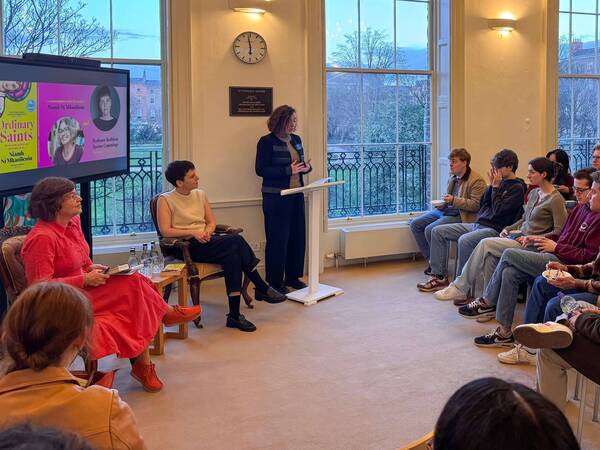
On March 9, 2026, Notre Dame Dublin welcomed author Niamh Ní Mhaoileoin to join Professor Kathleen Sprows Cummings in conversation about Ordinary Saints, Ní Mhaoileoin’s debut novel. The two weaved literature, history, and theology together as they engaged in a thoughtful discussion of faith, family, identity, and the institutions that shape how lives are remembered.
While developing Ordinary Saints, Ní Mhaoileoin sought to build a realistic portrayal of the Catholic canonization process, a central element of the novel's plot. To inform her research, she reached out directly to Professor Kathleen Sprows Cummings, whose scholarship has extensively examined the history of global Catholicism, women and gender, sanctity, and American religion.
Cummings, a professor of history and American studies at the University of Notre Dame, is the author of A Saint of Our Own: How the Quest for a Holy Hero Helped Catholics Become American, a landmark study of the pursuit of canonized saints in American Catholic history. Drawing on years of archival research and expertise in the history of sanctity, Cummings provided Ní Mhaoileoin with valuable insight into the formal processes and cultural dimensions of canonization, helping to ground the novel's exploration of what happens when an ordinary life becomes the subject of extraordinary public devotion.
During the discussion, Ní Mhaoileoin reflected on how her own Catholic upbringing in Ireland informed the novel, which follows Jay, a young woman forced to confront her past when her deceased brother becomes a candidate for sainthood. Ní Mhaoileoin and Cummings explored questions at the heart of the book: Who gets to tell a person's story? How do institutions shape memory? And what happens when private grief becomes a public narrative?
The conversation also offered an opportunity for Ní Mhaoileoin and Cummings to explore the ways scholarly research can inform and enrich creative work. While academic historians and novelists often pursue different goals, both rely on careful investigation, deep engagement with sources, a commitment to understanding the complexities of human experience, and the construction of narrative to share that information.
The event was co-sponsored by Notre Dame's Global Catholic Research Initiative (GCRI), which supports interdisciplinary research on Catholicism as a global phenomenon. As director of the initiative, Cummings noted that conversations such as this one reflect the value of bringing academic scholarship into dialogue with the arts.