Lizzie Stifel discusses international sustainability experiences, upcoming Global Day of Action

As we approach the University’s Global Day of Action, and consider what we might do to participate, we can look to those within our Notre Dame community for inspiration. One such example can be found in Lizzie Stifel.
Lizzie moved to Sri Lanka three short months after graduating from the University of Notre Dame with a bachelor of arts in political science and global affairs and a minor in data science. A recipient of the Princeton in Asia Fellowship, Lizzie will be undertaking a communications and outreach work placement at the International Water Management Institute, a global leader in water management solutions and research headquartered in Colombo, Sri Lanka.
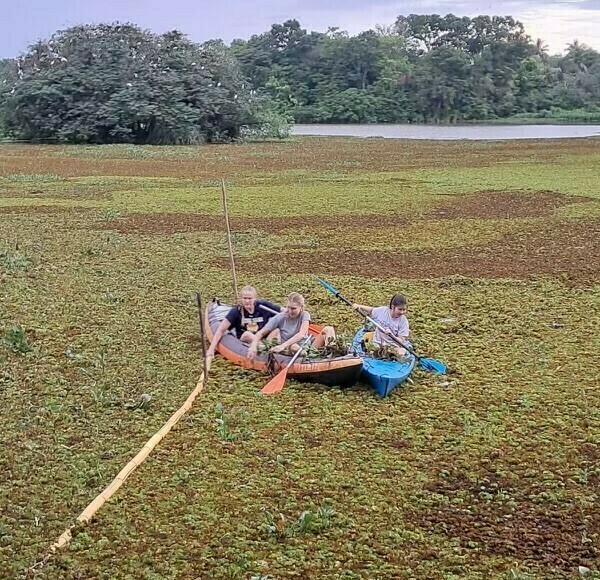
Lizzie is no stranger to the complexities of global water management and environmental protection. After graduating from high school, she took a gap year on the Kennedy-Lugar Youth Exchange and Study Program in Dakar, Senegal, where she assisted a national arts organization in the delivery of a climate-themed arts and education talent show. While at Notre Dame, she spent fall semester of junior year in Copenhagen studying sustainable development in northern Europe, followed by a summer on the Notre Dame Dublin Irish Internship Program where she conducted research with the Urban Citizen’s 632 project—a DCU Water Institute initiative utilizing citizen science and community-based monitoring to gather data on water quality in the Dublin Bay Biosphere led by Susan Hegarty, Ph.D., associate professor of physical and environmental geography at Dublin City University. Returning to Notre Dame for senior year with a myriad of global sustainability experiences and education, Lizzie took on a leadership role in student government as director of the department of sustainability with the platform “A Move Towards Zero Waste.”
Lizzie firmly believes that her time spent abroad has had an indelible impact on her perception of environmental consciousness, something she will carry with her in her fellowship with the International Water Management Institute in Sri Lanka. Through study, research, and immersion experiences on different continents, in different countries, Lizzie has come to understand the multidimensional nature of global water management, illuminating a diversity of approaches to sustainability.
“Culture is so important to understanding the universality of sustainability because we need to see what conditions these systems operate in to truly realize how context-dependent the work of environmental activism is,” asserts Lizzie.
“Water and food look different everywhere, so we need to make sure we’re respecting different cultures and making work meaningful for the places we live in.”
Lizzie’s research with the DCU Urban Citizen’s 632 project is a noteworthy example of how sustainability in Ireland is addressed in a distinct sphere from other international practices. As one of two social scientists on the research team, Lizzie’s academic background afforded her the skills to “be creative” about water management, operating outside of the hard science space and concentrating on the human impact of this work. She focused on rolling out technology that can ease the project’s community outreach efforts, making water management knowledge and resources more accessible. Working with a wide variety of water management and sustainability interest groups, government bodies, and concerned individuals in Ireland gave Lizzie an extensive perspective on future career opportunities at the intersection of the environment and human interaction.
As a current Princeton in Asia Fellow, Lizzie is working on several outreach projects through the International Water Management Institute, including an open source survey on poverty in Sri Lanka, translating science outputs into content suitable for varied stakeholders and audiences, and coding an online game to simulate water management scenarios. The game will act as a teaching tool and engagement mechanism for individuals seeking to learn more about human interaction with water.
Lizzie is still actively engaged in the Notre Dame community and will be partnering with several members of the Notre Dame Club of Sri Lanka to facilitate a community event about conscious consumption this upcoming Global Day of Action on Wednesday, October 2nd, modeled after conscious consumption events she has hosted for high school students at the Overseas School of Colombo.
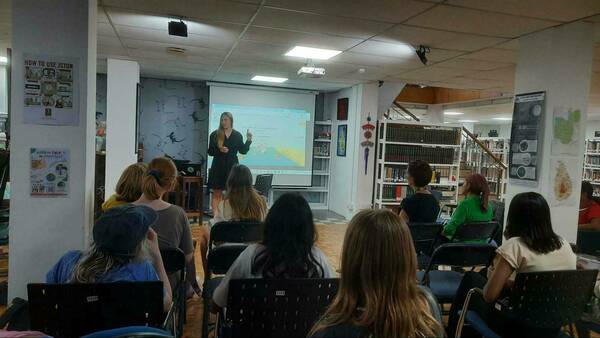
The Global Day of Action is a twice yearly event around Earth Day in the spring and at the apex of Notre Dame’s Saint Francis Week in the fall. Annually, during the first week in October, the University celebrates the legacy of Saint Francis, the patron saint of ecology and caretaker of all creatures. During this time, the Notre Dame community is encouraged to honor and continue Saint Francis' legacy and commitment to the environment.
In the lead up to the Feast of Saint Francis, Notre Dame Global and Notre Dame Sustainability invite members of the Notre Dame community around the world to engage in local activities that promote conscious consumption and environmental stewardship. In Dublin, study abroad students will be participating in several events across the week, including a sustainable soup dinner and a community discussion on Pope Francis’s encyclical Laudato si': on care for our common home. On this upcoming Global Day of Action, students will traipse the city on a thrift shop crawl to promote conversation about the impacts of consumerism and participation in Ireland’s circular economy. These events are spearheaded by the Notre Dame Dublin campus ministry graduate fellow and the undergraduate global sustainability fellows.
Lizzie regards such community events and action days as an important conversation catalyst, but she emphasizes that it cannot stop there. “It’s important to start an initiative and get people connected, but it is vital to be environmentally active beyond October 2nd,” she says.
“We need to make sure we’re not in a bubble,” Lizzie asserts when asked how to better promote environmental consciousness on and beyond campus. She invites both current Notre Dame students and alumni alike to bring people into the University’s sustainability network and carry out that action into the world.