Notre Dame Wireless Institute Faculty Builds New Research Ties in Ireland
of electrical engineering
Assistant Professor Toros Arikan of the University of Notre Dame’s Department of Electrical Engineering recently visited Trinity College Dublin to meet faculty and researchers from the Department of Electronic & Electrical Engineering; the CONNECT Centre, Research Ireland’s Centre for Future Networks and Communications; and Ireland’s Tyndall National Institute, a leading European deep tech research centre. The trip was supported by Notre Dame Global’s Ireland Research Development Grant with the aim of advancing potential research collaborations and grant proposals in the areas of wireless communications, remote sensing, and emerging 6G technologies.
Arikan was hosted by Professor Holger Claussen, head of the Wireless Communications Laboratory at the Tyndall National Institute, and professor of Wireless Communications at both University College Cork and Trinity College Dublin. Across a week of meetings and laboratory visits, the group explored opportunities for future collaborative research between the two institutions.
“Professor Claussen's team carries out world-class research in digital communications with both the Irish government and with industry, with a great track record of commercialization,” said Arikan. “At the Notre Dame Wireless Institute, we look forward to many years of joint research work and grant collaborations, with a wide variety of US and Irish agency partnerships.”
Arikan is a member of Notre Dame’s Wireless Institute, where his research combines digital communications, signal processing, and remote sensing to address real-world challenges including localization, environmental mapping, tracking, and communications in demanding environments. A particular focus of Arikan’s travel grant to Dublin is integrated sensing and communications (ISAC), a promising area that uses wireless signals for both communication and sensing applications. As 6G technologies advance, these capabilities will have profound societal impact, from improving everyday safety—such as detecting vehicles near pedestrian crossings—to more extreme emergency-response efforts in complex and hard-to-reach environments.
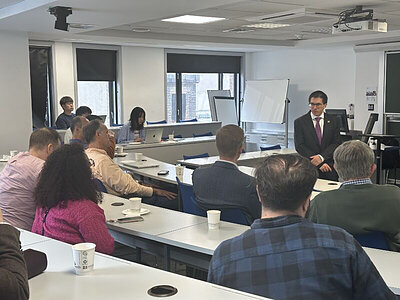
At Trinity, Arikan delivered a seminar titled “Deep Learning-Based Estimation of the Number and Locations of Reflective Surfaces for Underwater ISAC” to colleagues in the Trinity College Dublin Department of Electronic & Electrical Engineering at the CONNECT Centre. His presentation examined how deep learning could help address fundamental challenges in applying ISAC technologies to underwater environments, with potential implications for communications, sensing, and environmental monitoring.
“The strong official ties and goodwill between Notre Dame and its Irish counterparts helped to enhance the profile and turnouts of our meetings beyond what would be expected of the individual visit of a single professor,” Arikan stated. “The travel grant was essential in alerting me to the outstanding work of Professor Claussen and his research team, and kickstarted our collaboration much faster than is usually the case. The Notre Dame Wireless Institute would be delighted to reciprocally welcome Irish researchers to Notre Dame in the near future to deepen our joint research.”
Notre Dame Global awarded four, diverse Ireland Research Development Grants in collaboration with Notre Dame Dublin this year, spanning artificial intelligence, wireless communications, medieval studies, and contemporary Irish history. Learn more about the grant awardees here.
“We are committed to increasing faculty mobility to build research pathways for scholars on both sides of the Atlantic,” said Eimear Clowry Delaney, director of Notre Dame Dublin. “These types of weeklong knowledge exchanges allow Notre Dame faculty to deepen collaboration with our academic partners in Ireland, to share insights into current research at the University, and to consider new ways of working together into the future.”
The Ireland Research Development Grant is just one of Notre Dame Global's Global Network Research Development Grants, which link to the University’s 12 global locations in East Asia, Europe, Latin America, South Asia, and Sub-Saharan Africa. Several of the grants offer funds for faculty or postdoctoral scholars to travel to the indicated global location or region, while some also support Notre Dame applicants in bringing international collaborators to South Bend in order to further research endeavors and enhance collaborators' understanding of the University of Notre Dame. Learn more by visiting the Notre Dame Global website.