Professor Kevin Whelan Celebrates 28 Years with Exaugural Lecture on the Magic of the Irish Landscape
On April 23, 2026, over 250 friends, family, colleagues, alumni, students, and members of the Notre Dame community gathered at the Royal Irish Academy of Music to celebrate Professor Kevin Whelan’s remarkable 28 year contribution to the University of Notre Dame’s presence in Ireland. Whelan’s Exaugural Lecture, "Go Irish: The Magic of the Irish Landscape," marks his retirement from the University in summer 2026.
Watch the full lecture here:
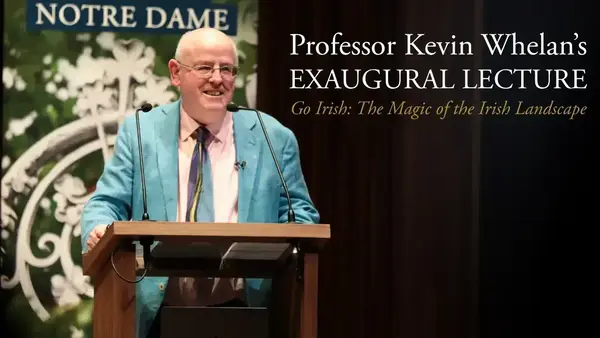
Opening the evening, Eimear Clowry Delaney, now director of Notre Dame Dublin, reflected on Professor Whelan’s extraordinary influence on the University’s presence in Ireland since he became the inaugural director in 1998. During his tenure, more than 4,000 Notre Dame students have come to Ireland, many of whom experienced the country through Whelan’s encouragement to explore beyond the familiar and discover the stories held within the landscape.
“Kevin has never been a dusty history professor,” Clowry Delaney said. “Whether in classrooms, museums or even on the Giant’s Causeway in the pouring rain and hail, he has practised history as a living art.”
She described how Whelan showed generations of students that “the past isn’t behind us. It’s beneath us, around us, deeply embedded in our language, our literature, our sports, our music, our culture. It’s in our experiences of place and of people.”
Over the years, Whelan led students across Ireland from Slea Head to Slieve League, Glendalough to Croagh Patrick, Kylemore Abbey to the Caves of Kesh, encouraging them to engage with Ireland not simply as tourists, but as pilgrims, as participants in a living cultural landscape.
For Whelan, a connection to place, to history, and to people has always been at the heart of the Notre Dame Dublin experience. Clowry Delaney recalled the countless memories shared by students and alumni, from hopping over stone walls in the Burren for the best view, to singing the Notre Dame fight song on Elephant Rock looking up at the Milky Way, listening to Irish poetry as the sun sets on Lough Ree, eating 99s absolutely everywhere, and returning years later to reminisce with Kevin over a cup of tea.
“His scholarship, spanning the ancient to the contemporary, has redefined the standard for how we connect the local to the universal, the past to the present,” she said.
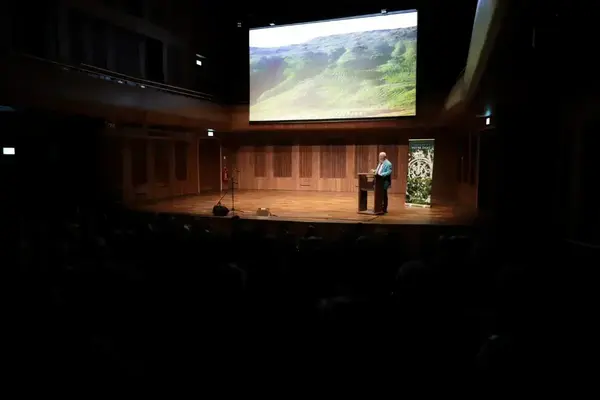
Beginning his lecture with characteristic humour, Whelan joked that he had another title to add to his list of achievements: “Cupid,” claiming responsibility as matchmaker to 81 marriages (give or take) between former students who met on the Dublin programme over the years.
His lecture explored Ireland as a place ultimately shaped by landscape, memory, and imagination. He described Ireland as an “edge experience”—an island at the edge of Europe and once at the edge of the known world—whose geography has shaped its history and identity.
Drawing on examples from nearly every county across the country, Whelan explored the hidden places and everyday landscapes that reveal Ireland’s deeper stories—mountains that have stood “in the silence before history,” ancient place names that preserve centuries of memory, stone walls built across generations, and natural wonders that continue to inspire a sense of mystery.
Like the proverbial excavation through the depths of the Irish bog, Whelan encouraged the audience to look beyond the surface of familiar places and recognise the layers of human experience embedded within them.
“Those kinds of spaces in Ireland are where I think the ancient magic happened,” he said, describing the hidden pools, mountains, islands, and coastlines that have captured the imagination for centuries.
Whelan also acknowledged the complexity of Ireland’s landscape. Alongside beauty and wonder, he reflected on the marks left by famine, emigration, conflict, and social change.
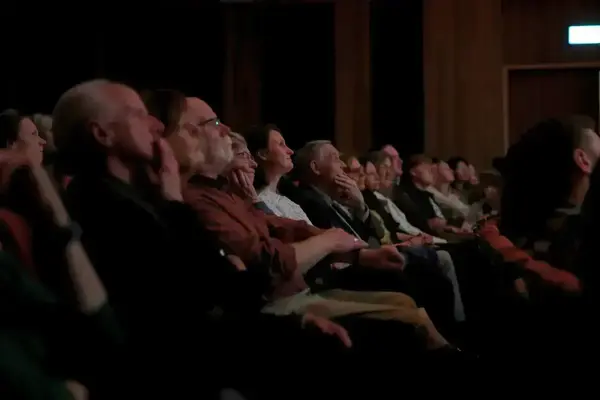
“Every inch of the land in Ireland has been paid for with the blood of a man,” he said quoting Belfast poet Medbh McGuckian, reminding the audience that Ireland’s geography contains at once its beauty and its struggle, a place where history is never distant.
Throughout the evening, Whelan returned to the importance of paying attention—not simply looking at the landscape, but learning how to see it, something he imparted on each and every Notre Dame student who crossed the threshold of O'Connell House.
He spoke of the “joy of small things”—old wells, traditional crafts, local stories, plants, animals, and ordinary places that often disappear from view in the shadow of great mountains and monuments.
And he even spoke of the joy of rain, to much laughter from the audience. “Rain imposes a slow life that encourages you to feel and to think,” he said. Rather than seeing rain as an annoyance, Whelan described it as a gift that has influenced creativity, conversation, and community, making it one of the most important influences on Irish culture.
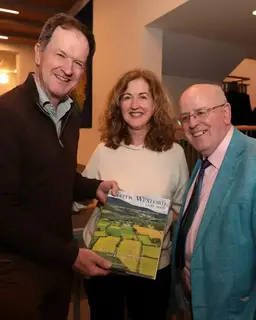
(2025, Cork University Press)
“I am because we were. I am because we are. And my story is always our story,” he ended, concluding a remarkable 28 year tenure, always in service of students and scholarship.
Kevin Whelan’s son, Ruaidhrí Whelan, wrapped the evening with a song he wrote for his father, weaving together many of the places, people, and memories of his beloved home county of Wexford that continue to shape his life and work.
Professor Kevin Whelan’s final lecture under the auspices of the University of Notre Dame was both a celebration of Ireland and a thank you to the many people who have supported the University’s work here. It was a fitting farewell from a scholar, storyteller and teacher whose greatest legacy may be the thousands of people who now understand a deeper sense of Ireland because of him.