Sister Damien Marie Savino Explores Faith, Science, and the “Language of Creation” with Notre Dame Dublin
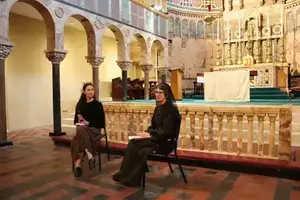
Notre Dame Dublin and the Notre Dame–Newman Centre for Faith and Reason welcomed Franciscan Sister Damien Marie Savino to Newman University Church on St. Stephen’s Green for a conversation on her new book, Learning the Language of Creation: Catholic Social Teaching and Integral Ecology. Sister Damien Marie is the Melchor Visiting Professor of Civil and Environmental Engineering and Earth Sciences at the University of Notre Dame.
Joined in conversation by Mariana Silva, PhD Candidate in Environmental Engineering at Trinity College Dublin, a Notre Dame and Naughton Fellow alumna, Sister Damien Marie reflected on how faith, science, and ecology can come together to shape a renewed understanding of humanity’s relationship with the natural world.
Watch the full lecture here:

The significant of gathering in Newman University Church, a space connected to the legacy of St. John Henry Newman and his vision of the relationship between faith and reason, did not go unnoticed. Sister Damien Marie acknowledged that St. Newman’s emphasis on the integration of faith and reason, as well as his philosophy of the “heart speaking to heart,” deeply resonated with the themes of her newest book.
Drawing on her background as a Franciscan Sister of the Eucharist, an environmental engineer, and an ecologist, Sister Damien Marie explained that she wrote Learning the Language of Creation to explore what integral ecology means in practice. Inspired by Pope Francis's encyclical Laudato Si’, she described integral ecology as a way of thinking that brings together human and natural ecologies, recognising that the flourishing of one is connected to the flourishing of the other.
Leaning on the great Franciscan theologian St. Bonaventure's idea that "every creature is a word of God, since it proclaims God," the crux of Sister Damien Marie's philosophy is that creation itself has a language, one that humanity is called to reengage with. By paying closer attention to the natural world, people can discover deeper insights about their place within it and their responsibilities toward one another and the environment.
Simply put, St. Bonaventure approaches the spirital journey with by describing "three steps" on a ladder to God: out, in, and up. "Out" involves going out, being attentive, and learning to listen; "in" means internalizing all that which you experienced, heard, and learned; and "up," where, through this process of listening, learning, reflection, and contemplation, we can we raise up others, ourselves, causes or concepts. Sister Damien Marie proposes that science and theology can work together as ways of listening to and interpreting this language.
Sister Damien Marie highlighted the emerging field of bioacoustics as one example of how listening more closely to creation can create major scientific breakthroughs. She uses a case study from a coral reef research group, where scientists have discoverd that by playing recordings of healthy reef ecosystems in damaged, silent reefs, they witnessed up to seven times more coral polyp colonization, demonstrating how understanding the patterns, rhythms, and sounds of nature alone can guide ecological healing.
Sister Damien also includes a case study of beavers being used as a cost-effective method to healing damaged landscapes in Utah. A group of engineers, ecologists, hydrologists, farmers, and ranchers across the state have listened to the language of the beavers, so to speak, and now know how to use the beavers' skills to strategically build natural dams in areas where they need to raise the water table. This group has created a natural solution to increase agricultural land quality and restore forage, with the added benefit of protecting land from wildfires, all at a fraction of the cost of a billion-dollar man-made dam.
When asked how individuals can begin living out integral ecology in everyday life, Sister Damien Marie returned to the importance of attentiveness. She encouraged people to cultivate habits of listening—to creation, to others, and to God—describing this as a necessary first step toward deeper ecological and spiritual awareness.
Sister Damien Marie emphasised that Catholic thought offers a “both-and” approach. Humans are neither separate from nature nor simply a problem for nature. Instead, humanity has a unique role as caretakers and cultivators, called to “till and keep” the earth with responsibility, humility, and care. This very human and often inefficient process should be viewed as a pilgrimage. Ecological conversion is not a single achievement but an ongoing journey of reconciliation, learning, and growth.
Through Learning the Language of Creation, Sister Damien Marie offers a vision of integral ecology rooted in Catholic social tradition, scientific understanding, and a renewed sense of wonder at the created world, inviting all to listen more carefully and rediscover their place within creation.